Predictive analytics is increasingly taking centre stage in disruption-prone global logistics, but the question is – is your data on the money?
Lance Pullan of TradeSight believe his aggregator has the ability to sharpen supply chain insight.
Responding to an article in November about the Western Cape Government’s announcement that it was looking at launching a “planning platform”, he lauded the news by Agriculture, Economic Development and Tourism MEC, Ivan Meyer.
“It is very encouraging to hear the initiatives being taken to address delays and costs at the Port of Cape Town – particularly the development of a data-sharing platform,” Pullan said.
Apart from Meyer, Western Cape Provincial MEC of Mobility, Isaac Sileku, said a strong and reliable logistics network was the backbone of the economy.
Pullan said both Meyer and Sileku “are to be commended for their vision and action”.
Ahead of November’s wind-bound downtime at the port, Pullan added he “can already see the good progress Transnet has made in turning things around in the container shipping sub-sector”.
Referring to TradeSight data, he said: “On a year-to-date (YTD) year-on-year (Y-o-Y) basis, October’s data from the last 12 months shows that the Cape Town Container Terminal as well as the Multi-Purpose Terminal have handled 21% more vessel calls than 2024.”
Pullan said his platform’s findings were aligned with those of national ports proprietor, Transnet National Port Authority (TNPA).
“This immediately tells us that there have been fewer and shorter delays this year. The increase in vessel calls facilitates an increase in container volumes.
“Using TNPA’s container volume database, we can see the port of Cape Town’s total volumes only increased by 10% on a YTD Y-o-Y October basis, which seems disproportional to the increase in vessel calls.
“If we dig a bit deeper, we can see full volumes were up only 7% while empty volumes were up 19% over the same period. This suggests the improved port productivity is allowing for a smoother flow of empty containers to support exports and that there is now more latent capacity in the overall system, which is encouraging. The Western Cape Government can certainly look to leverage this and stimulate more international trade-oriented businesses with the savings from using a platform already in place.”
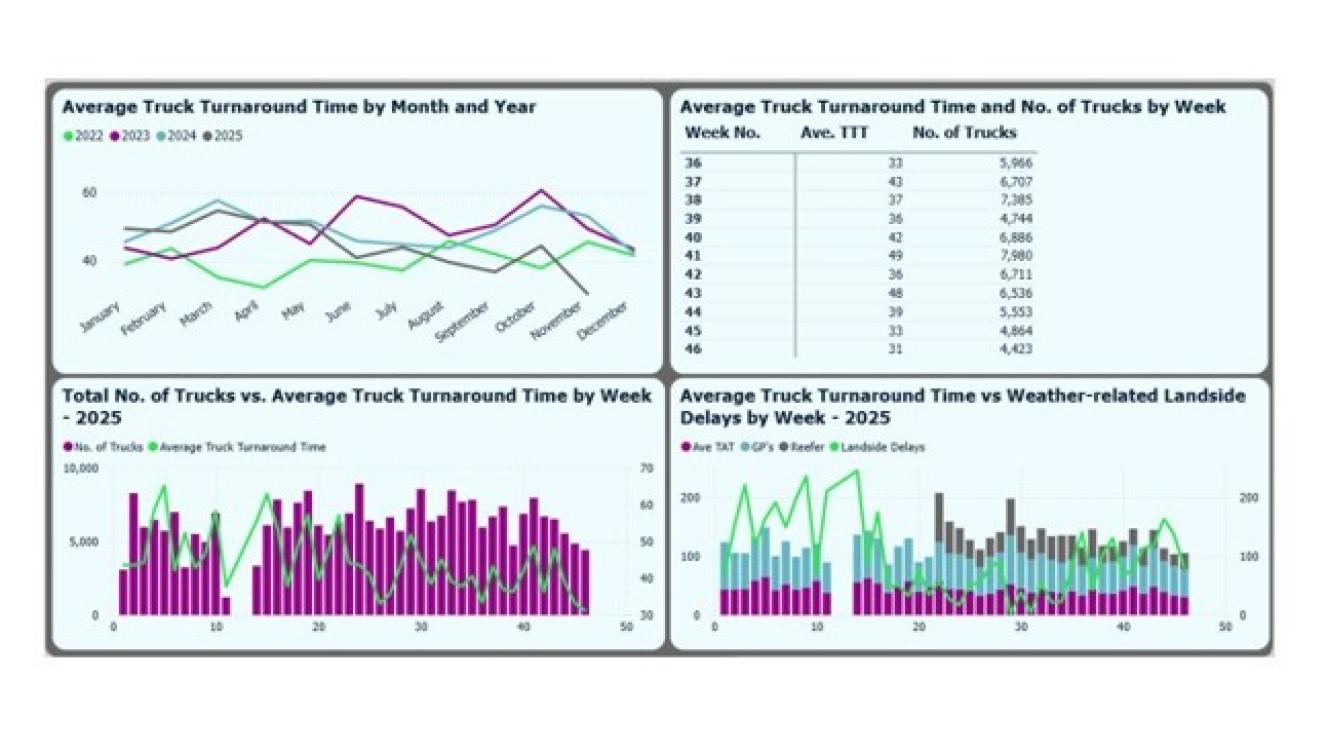
The Mother City’s port progress was also evident through data for productivity metrics, including landside interchange operations, said Pullan.
“Improvements can be seen with an overall downward trend in the average truck turnaround time at the Cape Town Container Terminal in 2025.”
Considering the amount of time often spent analysing data, it was important to make your data work for you as opposed to working extra hard to work through the data, Pullan explained.
“Having all the relevant information in one place is a major advantage. So, while having an accurate historic view is important, being able to look and plan ahead allows for better decision-making that ultimately results in higher volumes through the port.”