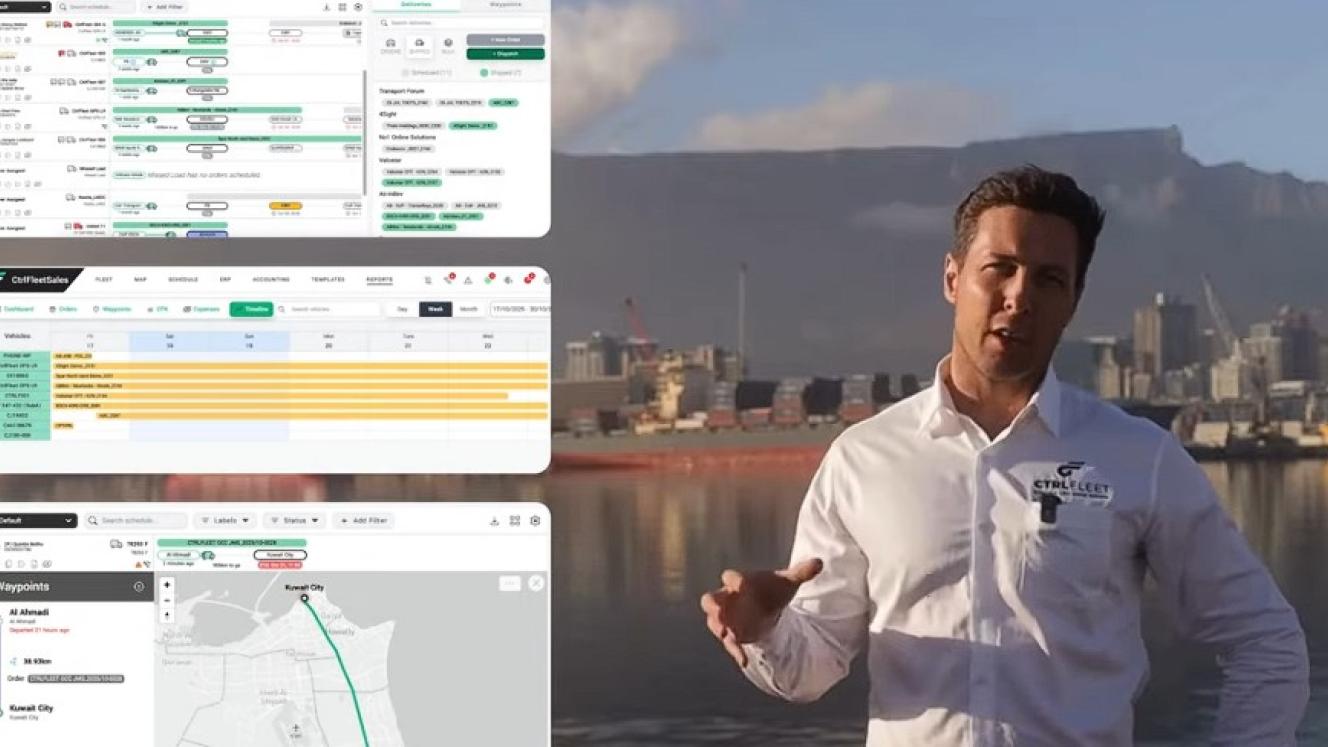
Avoiding digital disconnects between end-user clients and transport fleets is one of the primary goals CtrlFleet has identified for 2026, telematics expert Renko Bergh has told Freight News.
Celebrating CtrlFleet’s second anniversary on Friday, the company’s co-founder says they saw last year that there was an increased data-alignment need among operators.
“End-users have digitised themselves to a point where the applications they use and require transporters to use for compliance involve several service segments – order allocation, track and tracing, and digital documentation.”
He says even where drivers are concerned, fleet monitoring requirements have escalated in a positive way.
A regular question coming through from service providers, Bergh says, is how to synchronise services with end-user platforms.
“It means that you have to upskill or increase resources, and if your telematics is up to date, then the data is already there. You just need to integrate it.”
A nagging concern among transporters is that complying with pre- and post-trip information requirements, timeous order-responsiveness, prompts and notification in relation to route deviations takes a lot of manpower.
“But it doesn’t have to,” Bergh says.
“If the data is already there, you need to correlate it so it integrates seamlessly with your client’s own online requirements.
“The sweet spot for transporters is to first collate all data in one place, tracking your operational schedule, alerts and prompts, and then integrate it externally with an end-user’s digital platform. This needs to be done securely, ring-fencing data so that a transporter isn’t pulled in different directions.”
Creating the necessary digital cohesiveness, Bergh says, is what CtrlFleet refers to as “the network experience”.
How is this integration applied in real terms?
“Through two streams,” he says.
“One is obviously technical, while the other is focused on the process, especially change management. In certain situations, it comes down to the willingness of both parties to facilitate a digital solution.”