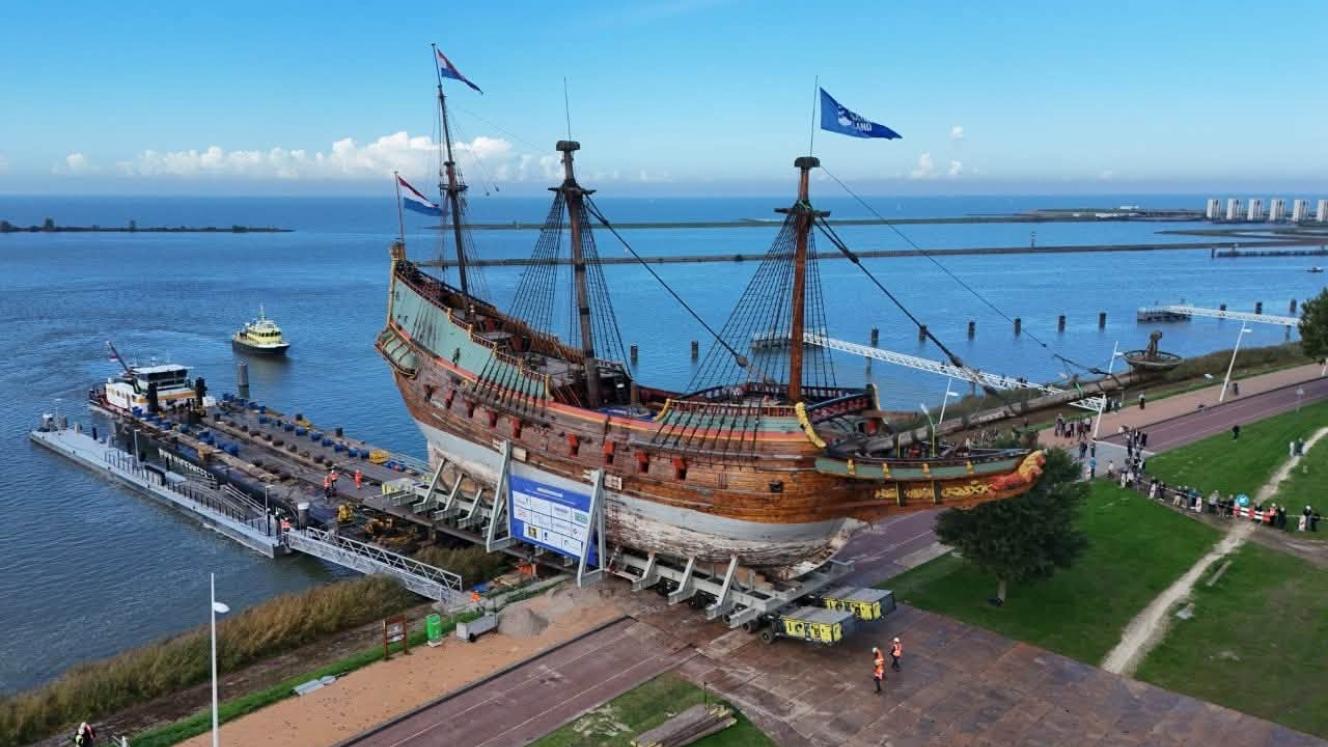
A 646 tonne wooden sailing ship has been moved ashore in the Netherlands using self-propelled modular transporters (SPMTs), completing an operation requiring 10 months of engineering, according to Museum Batavialand.
The Batavia, a full-scale reconstruction of a 1628 Dutch East India Company vessel completed in 1995, was transported across a dike to the museum grounds in Lelystad on October 2. It was lowered onto its permanent concrete foundation the following day.
Two SPMT trains, each comprising 28 axle lines, carried the vessel and its 101.2 tonne support cradle off a pontoon, up a purpose-built ramp and along a 250 metre route.
The 56-axle line configuration was determined by the need to keep the cradle rigid and protect the wooden hull rather than by weight alone, according to the project release. Engineering calculations established where the hull could safely be supported and the required height of each support point.
The vessel was prepared at Damen Shiprepair Amsterdam where it was placed in the specially built cradle before pontoon transport to Lelystad. Q3 Heavy Lift handled the detailed cradle engineering, SPMT transport, roll-off, jacking and final placement.
Crossing the dike was a key constraint because the land behind it lies below sea level. A long ramp provided a shallow approach angle while load spreading and crane mats helped distribute pressure along the route.
Ground conditions, underground services and anticipated ground pressures were assessed before the move. Lamp posts and other street furniture were temporarily removed to clear the route.
After leaving the pontoon, the transporters turned and reversed the vessel into position.
“It is only 250 metres but, if you drive over a pipeline you didn’t know was there, you have a problem,” said Ard Suvaal, Project Manager at Trans Global Projects, which managed the project, risk analysis, permitting and public safety.
“That groundwork is what makes the difference on a job like this.”
The operation involved close coordination between the technical partners and Dutch public works, water, provincial and municipal authorities.
The move intends to support the vessel’s long-term preservation by allowing its timber to dry and improving access for maintenance, according to the museum. The Batavia will be the centrepiece of the redeveloped Museum Batavialand, which is scheduled to open at the end of 2028.