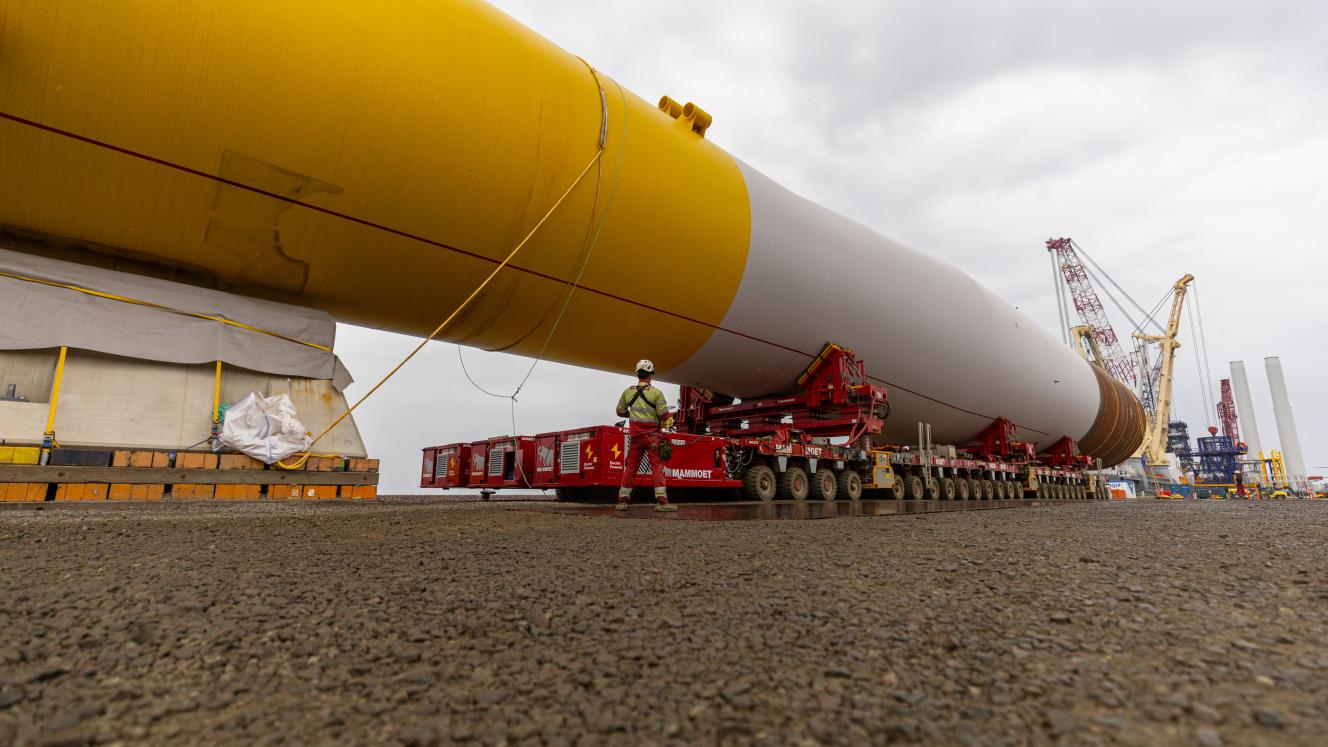
A 1 700-tonne offshore wind turbine foundation component has been moved using electric-powered heavy transport equipment at Denmark’s Port of Ronne, in a pilot testing electrification of project cargo handling.
Mammoet carried out the 815-metre movement during onshore marshalling for the Baltica 2 offshore wind farm, being developed jointly by Ørsted and PGE. The trial was conducted in collaboration with marine contractor Van Oord.
The heavy lifting and transport company described the pilot as the first electric-powered marshalling of a monopile under real-world conditions. Monopiles are large steel foundations used to support offshore wind turbines.
The movement used three sets of 26 axle lines of self-propelled modular transporters, fitted with Mammoet’s monopile handling system and powered by three electric power pack units.
“The transport was completed successfully, without charging and without impacting the project schedule,” said Mammoet global sustainability adviser Niek Bezuijen.
The pilot involved a single monopile within Mammoet’s wider scope to receive, marshal and load out 111 monopiles, each weighing 1 700 tonnes.
Based on data gathered during the trial, Mammoet said the system could perform all transport movements and transporter lifts needed to move a monopile from storage to the quayside on a single charge.
For a project with a similar layout, the company estimated that electric monopile transport could avoid between 25 000 and 30 000 litres of diesel consumption, equivalent to approximately 70 tonnes of carbon dioxide emissions. These are projected project-level savings, rather than measured savings from the pilot.
Van Oord’s Baltica 2 project manager, Tycho Muller, said the trial demonstrated that heavy onshore monopile movements could already be performed using fully electric equipment.