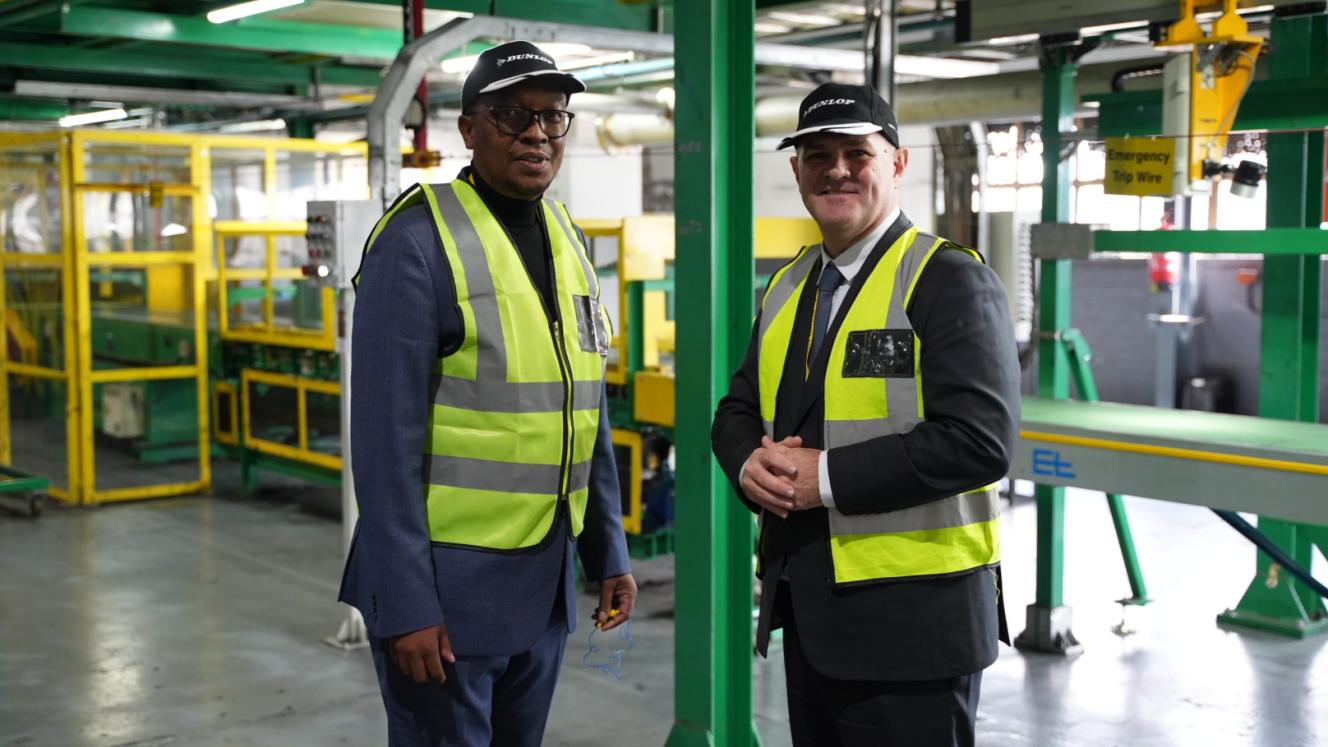
Dunlop Tyres South Africa has completed a R1.7-billion investment programme at its uMnambithi (Ladysmith) plant in KwaZulu-Natal, expanding production capacity for the local automotive industry and regional export markets.
Parent company Sumitomo Rubber Industries (SRI) of Japan backed the three-year capital investment, which expands production capacity for passenger, SUV and light truck tyres destined for original equipment (OE) manufacturers and export markets. The overhaul has equipped the plant with advanced compound mixers, new tread and sidewall lines, and next-generation curing technology.
Sumitomo Rubber Industries president and CEO, Yasuaki Kuniyasu, speaking at the launch of the upgraded facility in uMnambithi on Thursday, said South Africa held strategic importance within the group's global ambitions.
“Within our global strategy, our business in South Africa holds a very important place. Here, the automotive industry is one of the key industries that supports the nation's economy and employment. To take part in that industry means a great deal to us,” said Kuniyasu.
“As a tyre maker rooted in this region, supplying high-quality tyres reliably to our OE customers is both our responsibility and our great pride.”
The facility is a key supply node for major vehicle assembly plants, including Toyota, Isuzu, Ford, Volkswagen and Nissan. Beyond supplying local assembly lines, including the new AT31 tyre fitted to the Toyota Hilux, the upgraded facility strengthens Dunlop’s export network across 23 African countries, including Nigeria, Kenya, Côte d'Ivoire, Zambia and Zimbabwe.
The new machinery also allows the plant to manufacture new-generation, low rolling resistance tyres, which reduce energy consumption and help vehicle manufacturers meet increasingly stringent global vehicle emissions and efficiency regulations.
Dunlop Tyres South Africa CEO Lubin Ozoux said the investment marked an important milestone in the company's sustainability and innovation journey.
“This investment is about far more than infrastructure and technology. It positions our uMnambithi operation at the forefront of tyre manufacturing innovation in Africa while enabling us to produce the next generation of tyres required by vehicle manufacturers and consumers.
“The new technologies improve quality, efficiency and performance while supporting the production of very low rolling resistance tyres that will help vehicle manufacturers meet future emissions and efficiency requirements.”
Speaking at the event, Minister of Trade, Industry and Competition, Parks Tau, thanked the company for “continuing to bet” on South Africa. He said the government would match private industrial capital investment with policy certainty.
“This plant does not stand alone. It sits at the centre of South Africa’s automotive value chain, supplying original equipment partners that include Toyota, Isuzu, Ford, Volkswagen and Nissan. A R1.7 billion investment in local manufacturing is sustained by a fair and level playing field, and government understands that building that playing field is our collective responsibility.”
Tau said the South African Automotive Masterplan and its APDP2 support instruments were under review to assess performance against 2035 targets for jobs, localisation and growth, as well as to prepare policy frameworks for New Energy Vehicles.
“Second, and most fundamentally, we will keep choosing to invest in facilities like this one, because the answer to import pressure is not ‘retreat’. It is competitiveness – the kind this plant is demonstrating today.”
The uMnambithi facility is also a major employer in the uThukela district. Direct employment at the plant grew by 41% between 2014 and 2022, while the operation currently employs more than 1 500 people. Of these, 81% are drawn from the local Alfred Duma municipality and 87% from the broader district.