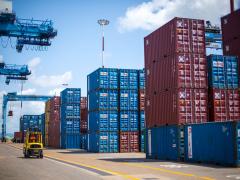
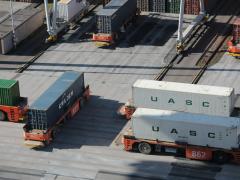
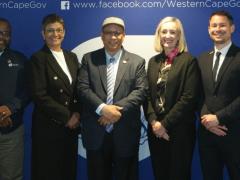
Dennis Trotter, SACD Freight: SACD has been a customs-licensed company since its inception in 1977 and one would have imagined that if a significant change to operations was intended that we and other industry players would have been consulted in order to ascertain the impact of such changes. The proposed change to clear all containers at the port of entry will have a major effect on our City Deep operation as well as other licensed facilities. While it may sound like sour grapes for me to pass negative comments due to the impending loss of business, the real effect of the new bill will be to create even more congestion at the port gates and force increased volumes of traffic onto the roads and away from rail which is not what government wants to achieve. Cobus Rossouw, IMPERIAL Logistics: In pursuit of protecting our country’s border, Sars seems to have under-estimated the complexity of current international logistics operations. To clear all cargo at sea ports will have dramatic implications for multi-modal container logistics. However, I am hopeful that some resolution will be found, even if it means that traditional customs clearing and forwarding processes need to be updated to accommodate end-to-end visibility across the supply chain. This will require collaboration between all role-players. James Gorrell: MSC Logistics One of the impacts could be increased paperwork as the new bills will make it mandatory for a customer/clearing agent to clear containers at the port of entry. Failure to do so will mean one will have to pass a Removal in Bond (RIB) entry to move containers to City Deep or alternatively other inland terminals or to pass a Removal in Transit (RIT) entry for containers destined to countries outside of South African borders. Groupage containers would be entered as an RIB movement at first port of entry in terms of section 105 of the draft customs control bill and transported to Johannesburg or to an inland terminal where a second clearance would need to be passed to, for example, enter the goods for home consumption or warehouse them. At this stage it is unclear whether Sars would require that the different parcels be declared or whether the container itself could be sent on a single entry, which with any luck would prove to be the case. The customs bill is not finalised and definitely would require more public and industry opinion before final legislation can be passed. Pat Corbin: Johannesburg Chamber of Commerce and Industry The issue of the new customs bills is one that is relatively simple. It is, however, the unintended consequences of this act that are very wide and will have far-reaching effects on inland ports such as City Deep. The consequence of passing this act in its current form is that one will be removing the status of City Deep as an international gateway and hub and increasing the pressure on the ocean ports in the country that are already under pressure. We are working very closely with customs in an effort to lobby for the industry to try and find a solution to the impact of the proposed bills. INSERT & CAPTION 1 The real effect of the new bill will be to create even more congestion at the port gates. – Dennis Trotter INSERT & CAPTION 2 Sars seems to have underestimated the complexity of current international logistics operations. – Cobus Rossouw INSERT & CAPTION 3 The consequence of passing this act in its current form is that one will be removing the status of City Deep as an international gateway and hub. – Pat Corbin
Customs Bills – what impact?
Comments | 0
© Now Media. This content is protected by copyright and may not be adapted or republished. If you would like to discuss cooperation opportunities, please contact: editor@freightnews.co.za.