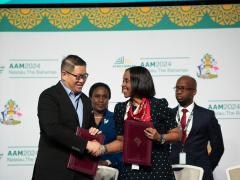
Marking a significant step forward in efforts to accelerate the preparation and facilitation of financing for priority cross-border infrastructure projects aligned with Agenda 2063, African Heads of State and Government last week launched the Africa Infrastructure Financing Facility (AIFF).
The launch took place during the Third Presidential High-Level Dialogue of the Alliance of African Multilateral Financial Institutions (AAMFI), convened on the margins of the 39th African Union Summit under the theme: “Strengthening Africa’s Financial Architecture to Finance Agenda 2063.”
Agenda 2063, the African Union's 50-year strategic framework and blueprint for transforming Africa into a global powerhouse, continues to face financing constraints.
These are driven by fragmented capital markets, elevated cost-of-capital premiums, limited long-term funding, and persistent reliance on external financial systems that do not fully reflect Africa’s development realities.
Against this backdrop, African leaders have emphasised the need to strengthen existing African Multilateral Financial Institutions (AMFIs) while accelerating the operationalisation of African Union Financial Institutions.
“Africa has domestic capital pools exceeding $2.5 trillion,” said President of Ghana, John Dramani Mahama.
“The challenge is not the availability of capital, but how intentionally we deploy it into infrastructure, industrialisation and job creation to realise Agenda 2063 and the African Continental Free Trade Area.”
He underscored the importance of reducing dependency on fragmented financing systems that misprice Africa’s risk and called for a coherent continental financial architecture capable of financing Africa’s development sustainably.
“The launch of the AIFF is a powerful demonstration of what can be achieved when political will and institutional coordination converge. We are confident that this facility will contribute meaningfully to closing Africa’s infrastructure financing gap, estimated at approximately $221 billion annually over the period 2023 to 2030,” said the AU’s Francisca Tatchouop Belobe.
Highlighting the importance of the facility, Dr George Elombi, president and chairman of the Board of Directors of Afreximbank, said: “The Africa Infrastructure Financing Facility has been designed to address the most persistent constraint to infrastructure delivery in Africa: the gap between political approval and financial execution.
“Too many projects stall not because they lack relevance, but because they are insufficiently prepared, inadequately structured or misaligned with the requirements of long-term capital. African Multilateral Financial Institutions understand African risk, African markets and African development realities. By pooling expertise, balance sheets and risk frameworks, the facility moves Africa from fragmented interventions to a coherent system capable of mobilising capital at scale.”