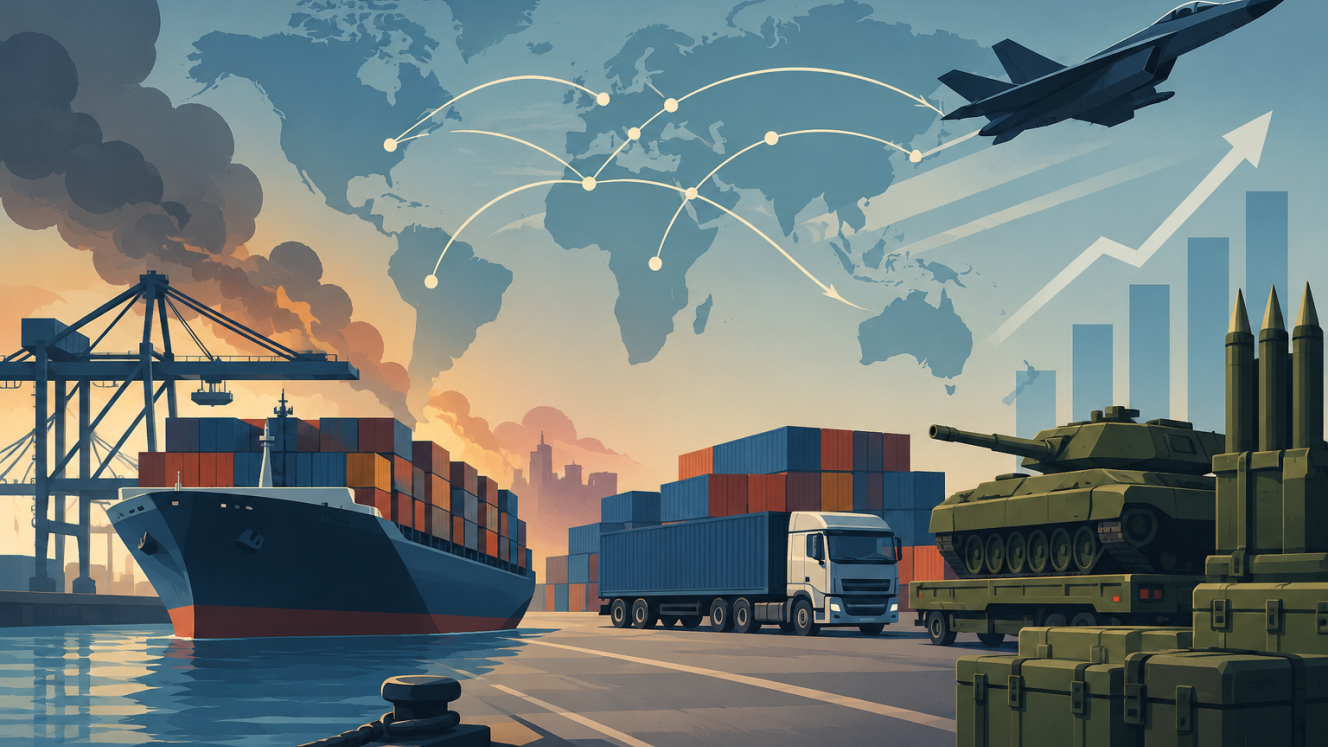
Wars are good business for shipping, logistics and some manufacturing sectors. The Stockholm International Peace Research Institute (SIPRI) reports that global military expenditure reached US$2 887 trillion (about R47.58 trillion) in 2025, up 2.9% in real terms from 2024, with particularly strong increases in Europe, Asia and Oceania.
The world’s leading authority on tracking arms transfers and military expenditure finds “arms-exporting states are often directly or indirectly affected by the conflicts or tensions driving demand in importing states, which partly explains why they are willing to supply arms even when this seems to contradict their stated arms export policies.”
The volume of major conventional arms transferred internationally rose by 9.2% between 2021-25 and 2016-20, which is the highest since the end of the Cold War.
This surge is putting pressure on international transport and supply chains with the logistics sector experiencing structural strain, cost escalation and capacity crowding, according to SIPRI.
The 25 largest suppliers accounted for 98% of the total volume of exports with the top five – the USA, France, Russia, Germany and China – supplying 70%.
South African defence exports to 115 countries were valued at over R10 billion in 2025, ranking it 18th on the SIPRI list.
US arms exports grew by 27% from 2016-20 and 2021-25, increasing its share of global arms exports from 36% to 42%.
Known plans for future deliveries strongly indicate that the US will remain by far the world’s largest arms exporter, according to SIPRI.
The US is directly and indirectly involved in conflicts in Iran, Somalia, Yemen, Ukraine and Israel.
In contrast to the US success, Russia’s arms exports more than halved from 2016-20 and 2021-25 (-64%), giving it a global share of 6.8% – a level far below any previous five-year period in its history or in any previous five-year period since 1950 for its predecessor, the Soviet Union.
Russia’s main conflict is its invasion of Ukraine, which has seen arms exports fall by 64% in five years, according to SIPRI.
Ukraine’s arms producers have, in contrast, become exporters of equipment and technology.
The five largest recipients were Ukraine, India, Saudi Arabia, Qatar and Pakistan, which together accounted for 35% of total arms imports in the period.
Ukraine was the world’s largest recipient of major arms in 2021-25, receiving 9.7% of total global arms imports in 2021-25 compared with 0.1% in 2016-20.
Arms imports by states in the Americas increased by 12% while imports by states in Africa (-41%), Asia and Oceania (-20%) and the Middle East (-13%) decreased.
Arms exports of the 27 European Union member states rose 36% between 2016-20 and 2021-25, giving them a 28% market share, which is five times higher than China’s.
European arms imports more than trebled between the two periods, reaching a level far higher than at any time since the end of the Cold War and making Europe the largest importing region for the first time since the 1960s.