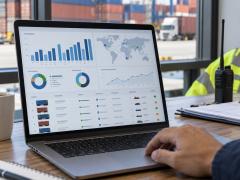
The real value of AI in logistics lies not in replacing people, but in enabling better decisions through the analysis of large volumes of data. According to Johan Eksteen, business manager for connectivity and products at SGS South Africa, AI is already delivering measurable benefits in customs risk management, tariff verification, cargo screening, trade analytics and anomaly detection. “Rather than reviewing every transaction manually, customs authorities and logistics operators can use intelligent systems to identify exceptions, high-risk shipments and valuation anomalies for further investigation.” For SGS, its value is particularly evident when combined with trade facilitation and customs technologies. This allows authorities to process growing transaction volumes while directing resources towards genuine high-risk activities, improving efficiency, revenue collection and compliance without unnecessarily delaying legitimate trade. Digital customs gathers pace This is taking place against a broader shift away from manual, document-driven processes towards integrated digital trade and customs platforms. Eksteen said governments, customs authorities, ports and logistics operators were increasingly using technology to improve visibility, automate decision making and reduce border delays. “We are seeing growing demand for solutions that provide real-time access to trade data, automate customs processes and improve compliance management. In Africa, in particular, technology is helping governments balance trade facilitation with revenue protection.” This has also driven increased adoption of Single Window platforms, e-Customs solutions and automated valuation systems, which Eksteen said were enabling faster cargo clearance while strengthening risk management, transparency and revenue assurance. The implementation of Single Window platforms allows traders to submit information once through a single digital interface rather than dealing independently with multiple government agencies. According to Eksteen, this can reduce processing times, improve transparency and simplify trade procedures. Automated customs valuation is also changing the way import transactions are assessed. By comparing declared values against established reference information and risk indicators, these systems can flag potential under-valuation while allowing compliant trade to move more efficiently. This enables customs officials to focus their attention on higher- risk transactions rather than manually reviewing large volumes of declarations, while helping governments strengthen compliance and revenue collection. Turning data into intelligence Despite these advances, Eksteen said the industry had made more progress in collecting data than in turning it into actionable intelligence. “Many organisations can now track cargo, monitor transactions and access operational information in real time. However, the next challenge is using that information to predict risks, improve planning and support decision making,” he told Freight News. In customs and trade facilitation, data can be used to identify trade patterns, assess compliance risks, improve valuation accuracy and optimise inspection resources. However, one of the biggest remaining challenges is integrating information from multiple systems and organisations into a single decision-making environment. He said those that successfully combined data, analytics and automation would realise the greatest operational and commercial benefits. Cyber risk grows with connectivity Greater connectivity, however, is also increasing the industry’s exposure to cyber risk. According to Eksteen, as ports, customs systems, freight forwarders, transport operators and cargo owners become increasingly interconnected, cybersecurity is becoming a business continuity issue rather than simply an IT concern. Ransomware attacks, data breaches, fraud, operational disruption and vulnerabilities within third-party systems are among the risks requiring greater attention. “As supply chains become more digital, organisations must not only prevent cyber incidents, but also ensure they can rapidly investigate, contain and recover from attacks when they occur.” Cybersecurity is not the only challenge associated with digital transformation. Eksteen said one of the biggest hurdles remained the successful integration of technology across multiple stakeholders. Many organisations still rely on legacy systems that do not communicate effectively with other platforms, while skills shortages, infrastructure constraints and varying levels of digital maturity remain challenges in parts of Africa. Despite this, he said progress was accelerating as governments and businesses increasingly recognised the role of digitisation in facilitating trade and improving competitiveness. “The organisations achieving the best results are those that focus on digital transformation as a business strategy rather than simply an IT project.” Looking ahead, he said the greatest opportunity lay in the convergence of artificial intelligence, automated customs systems, integrated trade platforms and cybersecurity. LV
AI transforms logistics from data to decisions
Comments | 0
© Now Media. This content is protected by copyright and may not be adapted or republished. If you would like to discuss cooperation opportunities, please contact: editor@freightnews.co.za.