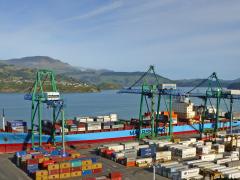
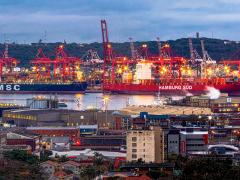
Import reliance on China blights rosy US picture 'US is lagging in general economic efficiency' WITH CARGO volumes up by a combined 13% last year at the nation’s two largest ports, Los Angeles and Long Beach, trade flows for the United States seem to be following the predictions of economists that the economy is still in good health and likely to remain so. Together the two ports moved a record 16 million TEUs during the year, accounting for just over 40% of the national total. That volume is less than impressive when measured against the performance of Asian ports. Los Angeles and Long Beach together are only fifth in the world rankings, with Singapore commanding the heights at 25 million TEUs. But behind the optimistic scenario is the increasingly lopsided reliance on imports, mainly from China. Imports now make up more than two-thirds of all trade for the country, adding to pessimists’ fears that the pressure on the currency and the current account deficit will become too much to bear in the next three to five years. The public message, put forward by cheer leaders for capitalism such as The Wall Street Journal, is that everything is rosy. The benchmark for optimism as always is oil and prices are falling, so the public is encouraged to believe that the only slight brake on prosperity is the war in Iraq. But reality always creeps through. Even the most fervent supporters of the economy acknowledge that the United States is lagging in general economic efficiency, no more so than in transport and shipping. The government has begun looking for ways to persuade importers and exporters to use American-registered ships and shipping lines, as rates are massively higher than those charged by foreign carriers. If the free market was allowed to operate the domestic shipping industry would be extinct and only the artificial device of the Jones Act (forcing all cargo between American ports to be carried on American ships) keeps it alive. In aviation, the ban continues on foreign companies owning a majority stake in American-registered airlines. Even the innovative Richard Branson has so far been unable to circumvent this, with his Virgin America two years late in launching and the head office in San Francisco still not set up. The pattern is being repeated throughout much of the economy, especially in the key sector of vehicle manufacture where Ford has run up the biggest loss in the industry’s history. Trade might be increasing but the once mighty dollar is suffering because of the one-way flow.
Martin Rushmere, FTW’s Los Angeles-based correspondent, offers his perspective on the US economic pi
Comments | 0
© Now Media. This content is protected by copyright and may not be adapted or republished. If you would like to discuss cooperation opportunities, please contact: editor@freightnews.co.za.