The Border Management Authority (BMA) has named the successful consortia that will redevelop South Africa’s six busiest land ports of entry under a R12.5 billion Public-Private Partnership (PPP) programme aimed at dramatically improving the efficiency of freight and passenger movement across the borders.
BMA Commissioner Dr Michael Masiapato, announced the development on Tuesday during a joint media briefing with Home Affairs Minister Leon Schreiber, noting that the project targeted the redevelopment of Beitbridge, Lebombo, Oshoek, Maseru Bridge, Kopfontein and Ficksburg Bridge.
“These six ports sit at the centre of regional trade and movement. Together, they account for over 80% of cross-border trade and passenger flows through South Africa’s land borders,” Schreiber said.
“Their performance has a direct impact on economic growth, revenue collection, and national security. For many years, however, these high-volume corridors have been under significant strain. Congestion, outdated infrastructure, and fragmented systems have slowed down trade and increased the cost of doing business.”
Schreiber added that these conditions had created an environment that was vulnerable to abuse.
“Weaknesses have been exploited through illegal migration, illicit trade, and fraudulent practices that undermine both revenue collection and the rule of law. In some areas, informal crossings and workarounds have eroded the integrity of our border environment.”
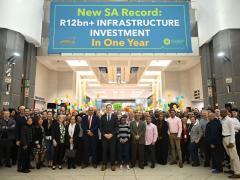
Schreiber said the R12.5 billion investment represented the largest investment in border upgrades ever undertaken by the country.
Masiapato highlighted that the new PPP initiative would see the selected concessionaires demolish and rebuild the facilities with modern, technology-enabled infrastructure designed to deliver shorter turnaround times, reduced congestion and more predictable movement of goods and people.
The successful bidders are:
- Beitbridge Port of Entry (Limpopo, northern corridor to Zimbabwe): Baobab Concession – Yakani Group, Wendra Infraco, Matla Integration, Tau Capital, Navigator Holding & Baobab Community Trust. Phased construction over approximately three years.
- Lebombo Port of Entry (Mpumalanga, eastern corridor to Mozambique): Raulux Consortium – Luxus Developments, Raubex, Exhantini Investments, Vulindlela Concessions, and Harith General Partners. Phased construction over approximately three years.
- Oshoek Port of Entry (Mpumalanga, south-eastern corridor to eSwatini): Baobab Concession (same composition as Beitbridge). Phased construction over approximately two years.
- Maseru Bridge Port of Entry (Free State, central corridor to Lesotho): Kgorong Consortium – Motseng Concessions, IDEAS Infrastructure, Crowie Concessions, & Thebe SPV. Phased construction over approximately two years.
- Kopfontein Port of Entry (North West, western corridor to Botswana): Kopfontein Consortium – Talis Property Fund, Unik Civil & Construction Engineers, and SSG Facilities. Phased construction over approximately two years.
- Ficksburg Bridge Port of Entry (Free State, central corridor to Lesotho): Imbani Consortium – Imbani Projects, Reaga Infra Border Holdings, M&M Capital and Russet Trading & Investments. Phased construction over approximately two years.
Masiapato said all preferred bidders had complied fully with the requirements of the Request for Proposals issued in 2024.
He said negotiations on the PPP agreements were advanced, with financial close expected to follow.
Construction is anticipated to commence later in 2026 or early 2027. The BMA is working on Budget Facility for Infrastructure (BFI) funding applications to support land acquisition and bulk services upgrades where required.
A key objective of the redevelopment is the implementation of the One-Stop Border Post (OSBP) model using a juxtaposed colocation approach. This will enable real-time coordination between South African and neighbouring country border agencies, supported by smart border technologies and non-stop freight movement under the Authorised Economic Operators (AEO) scheme.
Schreiber highlighted the expected efficiency gains.
“By redesigning our border posts around the latest world-class technology, embracing a Public-Private Partnership model, and adopting the One-Stop Border Post concept, we are fundamentally redesigning how our borders operate. We are moving from fragmented, manual processes to integrated, digital systems. From duplication and delay to coordination and convenience. From vulnerability, to control.”
He added that studies showed even a 5% reduction in border clearance times could boost intra-regional exports by around 10%.
“This is the scale of impact we are targeting.”
The project forms part of a broader border modernisation drive that includes the roll-out of the Electronic Travel Authorisation (ETA) system and other digital reforms. It is expected to reduce the cost of doing business, strengthen revenue collection by curbing illicit trade and under-declaration, and enhance national security.
The concessionaires will raise financing from commercial banks, with government repayment structured through a unitary payment model over the build-operate-transfer concession period.
Masiapato said in the coming weeks the BMA would intensify engagements with affected communities, municipal and traditional leaders, business chambers, freight associations and cross-border traders to address concerns before construction began. Provincial and local authorities have been urged to fast-track permits for the bidders.
Inter-governmental discussions with Zimbabwe, Mozambique, eSwatini, Botswana and Lesotho are at advanced stages to facilitate seamless OSBP implementation once the new infrastructure is complete.