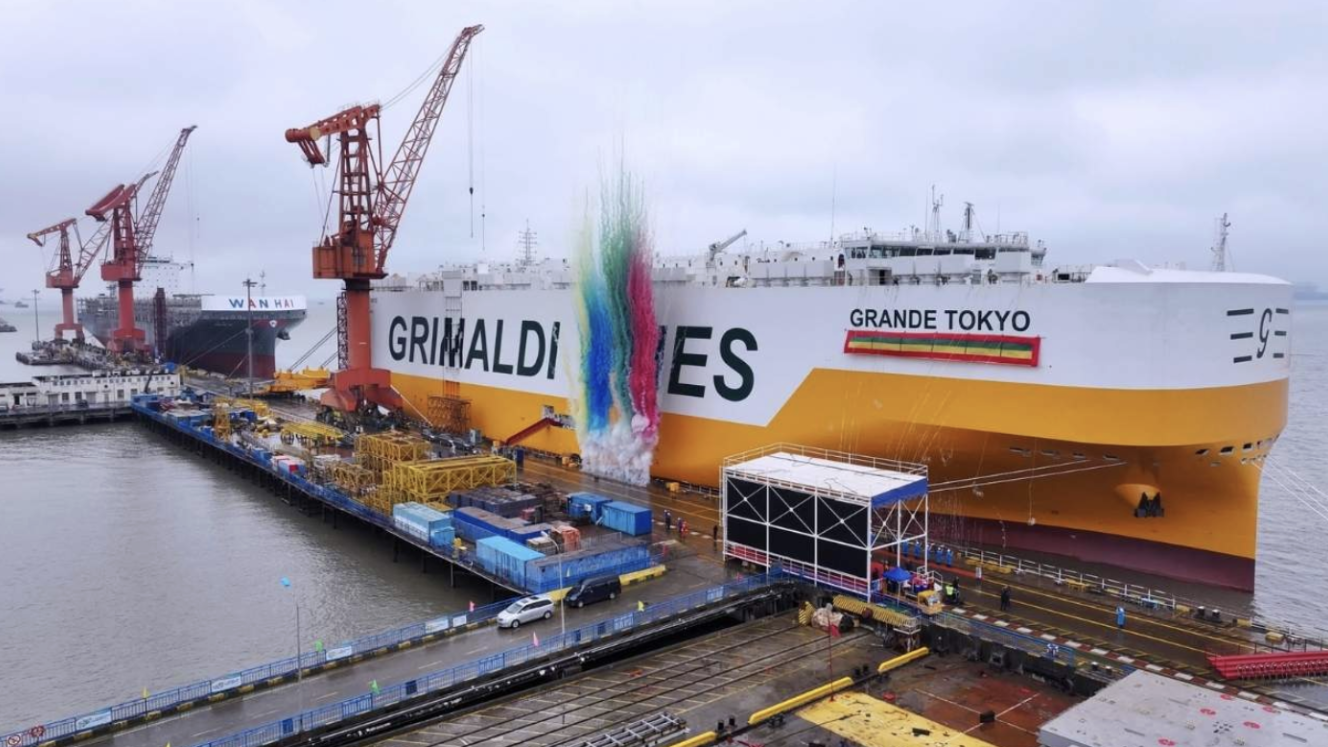
Italian shipping major Grimaldi Group has taken delivery of its latest Pure Car & Truck Carrier (PCTC), the Grande Tokyo, in Shanghai.
The vessel is the tenth ammonia-ready ship in the group’s expanding next-generation fleet and completes a series of seven sister ships built by Shanghai Waigaoqiao Shipbuilding Company Limited (SWS) and China Shipbuilding Trading Company Limited (CSTC), both part of China State Shipbuilding Corporation Limited (CSSC).
The Grande Tokyo was christened and delivered at a ceremony in Shanghai attended by senior representatives from the shipbuilder and the Grimaldi organisation. Zhang Wei, vice president of SWS, and Luigi Pacella Grimaldi, automotive intercontinental director of the Grimaldi Group, were among those present.
Spanning a length of 200 metres, a beam of 38 metres and a gross tonnage of approximately 77 500 tonnes, the Grande Tokyo offers a loading capacity of 9 241 CEUs (Car Equivalent Units). Four decks are strengthened for heavy and oversized rolling cargo up to 250 tonnes, with heights of up to 6.5 metres. The vessel is designed to carry a wide mix of rolling cargo, including cars, SUVs, vans and electric vehicles.
The ship is named after Tokyo in recognition of Japan’s importance in Grimaldi’s automotive logistics network.
“With our latest-generation ammonia-ready PCTCs, featuring high transport capacity and drastically reduced emissions, we have set a new standard of efficiency and environmental sustainability in global vehicle shipping along the main trade routes,” said Emanuele Grimaldi, managing director of the Grimaldi Group.
“We reaffirm our commitment to strengthening our role as a reliable partner for our customers, supporting their growth with increasingly advanced logistics solutions capable of adapting to the needs of an ever-evolving market.”
The Grande Tokyo is equipped with a modern, electronically controlled main engine that delivers low specific fuel consumption while meeting the strictest international limits for CO₂, NOx and SOx emissions. Through optimised hull design, energy-efficiency systems and higher cargo capacity, the vessel reduces CO₂ emissions per unit of cargo by up to 50% compared with earlier-generation car carriers.
It carries the “Ammonia Ready” class notation from RINA, allowing future conversion to ammonia as a zero-carbon fuel and is fitted for shore power connection (cold ironing) in ports where infrastructure is available.
She will begin her voyage in Ningbo, China, carrying approximately 6 800 vehicles bound for discharge in Brazil at Paranaguá and Rio de Janeiro.
The group operates regular services linking Asia with Europe, the Persian Gulf, East Africa and other regions, supported by a global network of more than 150 ports in 60 countries.