Market appetite of roughly R42 billion for Transnet’s gross debt burden of about R138bn bodes well for South Africa’s port and rail freight network in 2026, the most recent Cargo Movement Update (CMU) says.
Compilers of the update, the South African Association of Freight Forwarders (Saaff) and Business Unity SA (Busa), posit that this is despite the ‘lost years’ under the state capture government of former president Jacob Zuma.
“It points to sustained investor belief in the strategic value of the national freight network, notwithstanding the lost years and well-documented operational failings,” the CMU says.
“This interest reflects a forward-looking assessment that with credible reform, improved governance, and disciplined execution, logistics performance can recover. Ultimately, trade, transport and logistics remain foundational economic infrastructure. Their effectiveness will continue to shape competitiveness, investment decisions, and South Africa’s capacity to convert policy intent into real economic growth.”
Altogether it makes for a year in which collaboration in trade, transport and logistics is high on the agenda of industry ambitions, say Saaff and Busa,
Ultimately there are two major developments at Transnet that immediately come to mind.
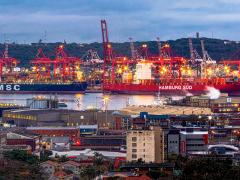
One is December’s official implementation of a public-private-partnership (PPP) deal whereby International Container Terminal Services Inc will manage 49% of Pier 2 at the Port of Durban for a period of 25 years.
Another exciting development is the country’s rail reform, poised to move from planning to implementation, whereby private train operators will be allowed slots on seven cargo corridors.
Under the open access framework, 11 private train operating companies (TOCs) have been selected and are progressing towards contract finalisation and safety certification.
Several are expected to commence operations in the second half of 2026, with others potentially starting in 2027, depending on the availability of rolling stock and operational readiness.
The move is forecast to increase annual freight volumes by approximately 20 million tonnes, supplementing TFR’s existing capacity and helping the government meet its target of raising rail’s share of freight transport by 2029.
Two leading logistics multinationals that have been identified as part of this process are Grindrod and Mediterranean Shipping Company.
The move is forecast to increase annual freight volumes by approximately 20 million tonnes, supplementing Transnet Freight Rail’s (TFR) existing capacity and helping the government meet its target of raising rail’s share of freight transport by 2029.
Transnet’s Rail Infrastructure Manager, the division overseeing this process, is continuing to refine the regulatory framework, publishing updated network statements and access rules that govern how third-party operators may use the national rail network. Invitations for slot applications for the 2026/27 timetable are expected during the year.
Private investment in rolling stock is also under way, with companies such as Traxtion committing hundreds of millions of rands to locomotives and wagons, marking one of the largest private freight rail investments in South African history.