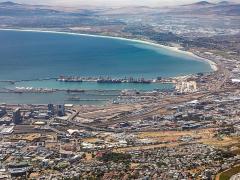
Freight capacity on the Trans-Caprivi Corridor is approaching the critical mass required to ensure that freight moves smoothly along the Walvis Bay- Ndola-Lubumbashi Development Corridor, says Andrew Sinyangwe, Zambian business development manager for the Walvis Bay Corridor Group (WBCG). “There is increased interest from the mines. We are now focusing on increasing truck capacity and storage in Walvis Bay,” he says. It is estimated that the corridor has the capacity to carry three thousand tons of cargo a month. Mines which have been testing the route with convoys of up to 25 trucks at a time are reporting that their cargo moves faster, and that the shipping is more efficient than on the other main routes, says Sinyangwe. So much so that exporters from Malawi have also started using the Trans-Caprivi Corridor in preference to those linking the country to much closer ports. According to the WBCG group, there has been a 75% increase in volumes along the corridor over the past year. “We are seeing growth in the full spectrum of cargo, and not only mining-related freight.” At present there is some capacity on the return journey as the corridor is presently carrying more imports for Zambia and neighbouring countries than exports, he says. The Walvis Bay Corridor Group is working closely with its members to help them benefit from the growth of the corridor. “Anyone who can offer a service and has the capacity to deliver is welcome to speak to me,” he says. Sinyangwe has hosted a number of information sessions for WBCG members wanting to expand their services into the Copperbelt and other regions. Members are also welcome to accompany him on his regular visits to market the corridor in the Zambian hinterland. “We believe there is massive potential to offer Walvis Bay as an alternative to Dar es Salaam and Durban. All the links are now in place.” Namibian customs is also working with the WBCG to facilitate the movement of cargo by creating common codes and doing away with bond fees for certain cargo, he says. Zambian hauliers have seen the opportunity and have increased the capacity on the route by up to 200 trucks over recent months. South African hauliers are also opening up companies in Zambia or buying into existing operations in order to service the corridor. Namport, for its part, continues to invest in the port of Walvis Bay in order to support the growing volumes. INSERT & CAPTION We are now focusing on increasing truck capacity and storage in Walvis Bay. – Andrew Sinyangwe INSERT 75% The increase in volumes along the corridor over the past year. CAPTION The Port of Walvis Bay ... viable alternative to Dar es Salaam and Durban.
Walvis Bay corridor volumes reaching critical mass
Comments | 0
© Now Media. This content is protected by copyright and may not be adapted or republished. If you would like to discuss cooperation opportunities, please contact: editor@freightnews.co.za.