The Port of Durban has seen significant improvement in container handling over the past 12 months, according to Transnet Port Terminals (TPT) CEO Nozipho Sithole.
“In the next five years we want to move from being a pure terminal operator to a facilitator of trade,” Sithole said. Alex Hill, part of the national executive of the SA Association of Ship Operators and Agents (Saasoa), said based on a five-month report of vessel calls supplied by one of the shipping lines, he had tracked the performance of SA ports in comparison to Abidjan Port in the Ivory Coast.
He said the report measured the same types of vessels and services and took into account wind delays when measuring the number of crane moves per hour. “Durban was averaging 30 moves over the ships rail per hour, Ngqura was doing 36 GMH (gross moves per hour) and Abidjan was doing 42 GMH on the same type of vessel on the same service. It gives an indication of where Durban is and where Durban hopes to be.
There has been considerable improvement,” Hill said. Hill said the target for DCT’s Pier 2 was 62 GCH (gross crane moves per hour) for Durban and performance had improved from 49 GCH in February up to 61 GCH in March. At Pier one the target was 53 GCH and productivity had increased from 41 GCH in February to 57 GCH in March.
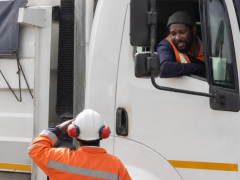
Hill said there was still room for improvement on the landside where approximately 50% of trucks were not meeting the agreed 90-minute target turnaround time at DCT’s Pier 2 from the time of arrival at A Check to leaving the port. He said TPT had not made statistics for Pier 1 available.
“From January on average 1970 trucks have been going through the port of Durban’s Pier 2 – and of that they handled an average of 2100 container moves of which 1400 trucks exceeded the 90-minute truck turnaround time,” Hill said.
“At the end of February we had 2200 trucks through DCT Pier 2 handling 2900 moves on average per day and 1200 of those trucks exceeded the 90-minute turnaround time,” Hill said. “But the good news is we are coming from an environment where trucks were sitting for 24 to 36. It is hats off to the current management team to have achieved quite a lot in a short period of time. We have however hit a brick wall and we don’t seem able to move forward from six hours to 90 minutes – but there has been huge progress.”
Hill said he was confident that port users would see further productivity improvement but there was “still quite a long way to go”.