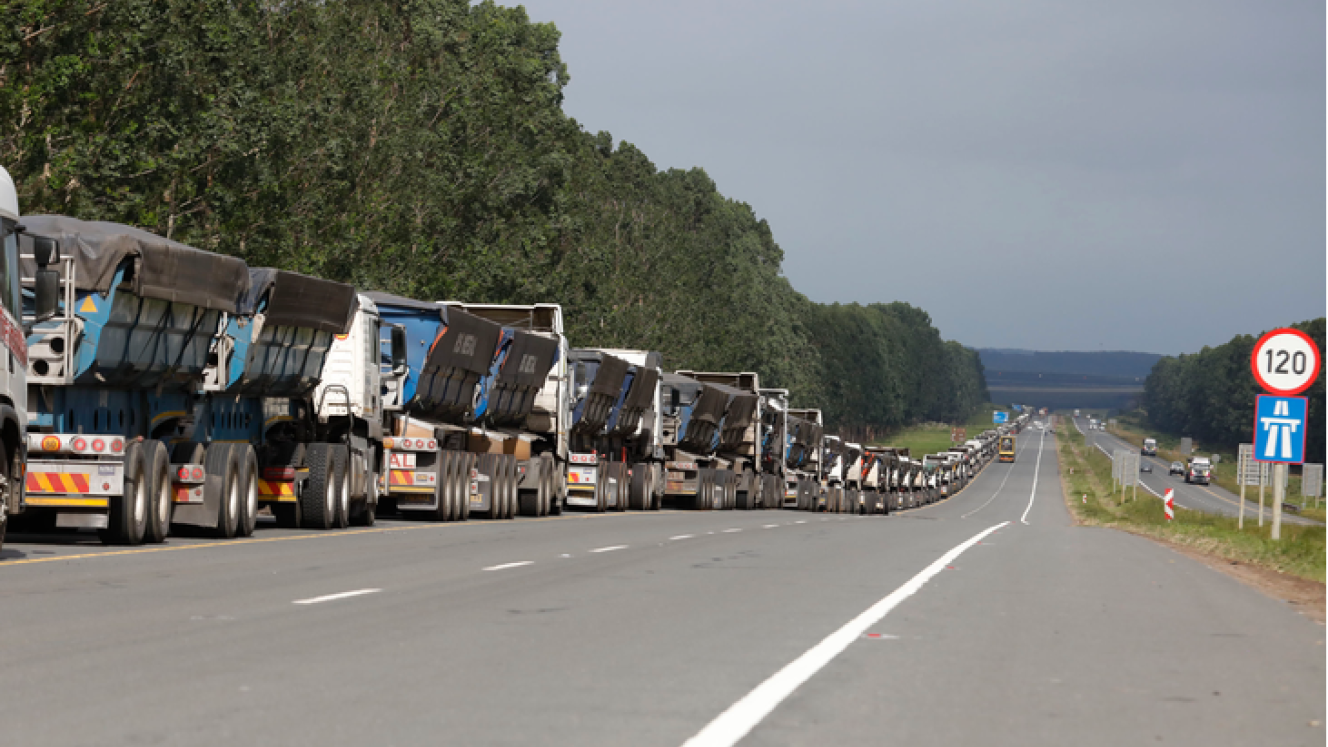
Truckers are up in arms over the newly announced tariff structure of the Gauteng Open Road Tolling system, which will see them having to fork out R3.96 a kilometre – 46 cents more than the anticipated R3.50 a kilometre. The SA National Roads Agency Limited (Sanral) announced the tariff structure for the 185-kilometre Gauteng Freeway Improvement Project (GFIP) last week, saying light motor vehicles would be charged 66 cents a kilometre and heavy-duty vehicles R3.96. This is, however, before discounts have been applied. “The fee structure will include discounts for offpeak travel, e-tag users, frequent users and qualifying public transport operators,” said Sanral CEO, Nazir Alli. Toll fees on the multi-lane free-flowing GFIP, also known as the open road toll system, will be collected through a series of overhead toll points (gantries). “These gantries are fitted with toll collection equipment that will recognise the electronic transender (e-tag) on a vehicle,” said Alli. “Tolls will be deducted from a user’s registered e-toll account associated with the vehicle and the user will be able to travel without any disruptions.” Heavy-duty vehicles fitted with the e-tag system will be charged only R2.97 per kilometre. “There are many trucks though that won’t qualify for all the discounts,” says Road Freight Association spokesman, Gavin Kelly. “The impact of these toll fees is going to be huge and it will impact the economy negatively as the goods on the shelves will ultimately increase in cost.” According to Kelly an impact study conducted in 2010 using R3.50 a kilometre as the measure showed some goods would increase in cost by as much as 25%. “In this system some goods will be tolled three or four times. We tabled our concerns at the time to the Ministries of Transport and Trade and Industry. One must also take into account that this study was done without taking the increase of fuel into consideration.” The RFA has been in talks with Sanral for several years around the toll system, but was never involved in discussions around the actual fee structure. “At some point though they became very cagey about the actual price, claiming it was confidential or complicated and finally in the last couple of months we had no interaction.” Kelly said they were shocked at the final fee structure as it was more than was expected. “We are going to do another impact study with an economist to try to determine what the real increase in cost is going to be. We will also have to take the fuel price into consideration as it is expected to keep climbing this year.” He said the impact on operating costs would depend on fleet sizes and how much the tolled ring road is used, but in some cases the bill would be a few million rand a month. “That money is going to be recouped from somewhere and it will be the consumer.” He said while there were not necessarily alternative routes, the toll road would result in heavier traffic in suburban areas as people tried to find other ways of reaching their destination. “And that does not just mean heavy duty trucks but rather all traffic is going to increase on the ‘alternative’ roads in the province. We continue to ask the question: “Was the toll road system really necessary for Gauteng and has anyone really taken the impact on the economy into consideration?” According to Alli discounts on the system will make all the difference as users will also be discounted on the frequency they use the ring road and at what times they drive. Revenue created through tolls will be used to foot the bill of the improved freeway estimated in the region of R20 billion. Road users will be required to set up an account with Sanral for the payment of the their toll fees. Each time a vehicle passes underneath a gantry, tolls will be charged. The cost per gantry is determined by the kilometre distance, which the toll point represents. The toll tariff is calculated by multiplying this distance, represented by the toll point, with the cents per kilometre rate. Gantries are situated on average between five and 14 kilometres apart. On this network a directional toll strategy will be implemented. This means at any one specific position, only one direction of the route is tolled. According to Alli the system will enter a test phase in April this year. It is expected to be fully operational by no later than June 23.
Truckers shocked over final fee structure
Comments | 0
© Now Media. This content is protected by copyright and may not be adapted or republished. If you would like to discuss cooperation opportunities, please contact: editor@freightnews.co.za.