The United States Central Command (CENTCOM) said on Monday that its forces would begin supporting merchant vessels transiting the Strait of Hormuz. The move follows a fresh attack on a bulk carrier, with security risks in the corridor remaining high.
United Kingdom Maritime Trade Operations (UKMTO) received a report of a fresh attack on a bulk carrier located about 11 nautical miles (about 20km) west of Sirik, Iran, on Sunday. “The master of a northbound bulk carrier has reported being attacked by multiple small craft. All crew reported safe and no environmental impact reported,” the UKMTO warning read.
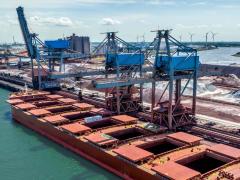
According to Maritime Executive, the vessel has been identified as the Minoan Falcon, a Greek-owned bulker of about 90 000 dwt. AIS data shows that at the time of the interdiction, the ship entered just inside Iran’s 12-mile (about 22km) territorial sea boundary, indicating either a diversion or an intent to use the tightly controlled route on Iran’s side of the waterway. The vessel departed the area safely.
CENTCOM announced on Monday that its forces would begin supporting “Project Freedom” to restore freedom of navigation through the Strait of Hormuz. The mission, directed by US President Donald Trump, will support merchant vessels transiting the corridor, which carries a quarter of the world’s oil trade at sea plus significant fuel and fertiliser volumes.
“Our support for this defensive mission is essential to regional security and the global economy as we also maintain the naval blockade,” said Admiral Brad Cooper, CENTCOM commander.
The mission includes guided-missile destroyers, over 100 aircraft, multi-domain unmanned platforms and 15 000 service members.
The US Department of State last week outlined a separate “Maritime Freedom Construct” to improve coordination and information sharing among international partners.
Overall risk ‘critical’
The latest Joint Maritime Information Center (JMIC) advisory on Sunday assessed the overall maritime risk level in the Arabian Gulf and Strait of Hormuz as critical, noting that traffic “remains significantly reduced”.
The advisory reported persistent congestion at anchorages, along with reports of mines near the traffic separation scheme (TSS) and ongoing global navigation satellite system interference.
Strait of Hormuz transits fell sharply. There were 10 transits on April 30, 15 on May 1 and only one on May 2, against a historical average of approximately 138 vessels per day. Bab el-Mandeb transits have totalled 104 in the past 72 hours, still below its 2023 baseline levels when the conflict emerged.
JMIC said it was maintaining a ‘critical’ threat assessment for the Arabian Gulf/Strait of Hormuz and Gulf of Oman/Arabian Sea due to navigation interference, blockade enforcement, mine reports and residual kinetic risk.
It advised operators to exercise heightened vigilance, apply Best Management Practices for Maritime Security measures where relevant, maintain prudent standoff from naval units and report suspicious activity to UKMTO.
The operating environment is expected to remain high-risk in the short term, with fragile ceasefire conditions and potential for rapid action near Iranian waters.