South African state
departments should lead
the way in addressing the
problems of non-tariff
barriers at home while
working with SADC
countries to implement a
long-overdue transit scheme
to improve trade flows to
landlocked countries.
This is the view of Dave
Watts, consultant to the
SA Association of Freight
Forwarders (Saaff), who
raised concerns over the high
cost of non-tariff barriers
(NTBs) during a Shepstone
& Wylie Shipping and
Logistics Summit in Durban
recently.
These include the “serious
problem” of bribery of
truckers along certain routes
in the SADC region which
ultimately raises the cost
of business and the price of
goods in inland provinces
and countries. NTBs
include any barrier to trade
or transport ranging from
police road blocks, import
and export licensing and
non-tariff customs delays
to health and veterinary
controls.
He said coastal transit
countries such as South
Africa had a responsibility in
terms of the United Nations’
law of the sea to facilitate
the movement of goods to
landlocked countries.
“NTBs are a real barrier
on the great north road
between Chirundu and
Lusaka.”
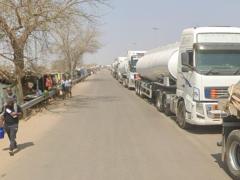
Watts said there had
been reports that truckers
driving along the road would
come across a row of empty
45-gallon drums, a
police stop, always late
on a Friday afternoon.
“To get past there you
need to pay and there
will probably be another
one on the other side of
Lusaka,” Watts said.
“At one stage I had a
report from truckers that
they
were approaching 30 stops
on the road, all of which
wanted some money. It is
absolutely outrageous.”
Watts said recent figures
provided by truckers who
were moving goods indicated
that it cost US$10400 to
move a 40-foot container or
a 45-foot semi-trailer from
Durban to Lubumbashi in
the DRC.
The US$10400 comprised
permits, levies, taxes and
fees with no mention of
bribes. However, he said
the actual trucking cost
of moving the cargo was
around US$ 7000.
“But if you ask a trucking
company on that route
they give their drivers cash,
suspiciously mostly in US
dollars – in order to get them
through. If they haven’t got
it they will be stopped and
have all sorts of problems,”
Watts said.
“It would
be $1000 at
best through
Lusaka; can
you imagine
the impact of
that on the
cost of living
in a country
like Zambia
and in the
Katanga
province
of DRC?
Spending that
kind of money
is really
seriously a problem.”
However, Watts said East
African countries had proved
that if there was a political
will to change the situation it
could be done. The corridor
between Kenya and Uganda,
for example, cost US$ 283 to
transit and it was taking six
hours to get a truck through
the Malaba border which was
a “huge improvement”.
Watts added that there
was a need to address the
faster facilitation of state
interventions in Durban
where freight forwarders
currently had a problem
with the state’s veterinary
services that were taking
up to five and seven days
to be completed, impacting
costs because beef, chicken
and pork had to be kept at
huge cost in a cold store or
connected to a reefer facility.
“We need to see
government stepping in to
say we must facilitate trade,
not just talk about it, really
facilitate it, and that goes
for all departments, customs
as well. They talk good
talk about
facilitating
trade but
from all the
talk we get I
am not sure
that happens,”
Watts said.
Transnet
National Ports
Authority’s
Lwandile
Mabuza
said it was
important for
the industry
and the port to
communicate
and collaborate in the
supply chain to improve
transparency and reduce
inefficiencies.
Mabuza said the port was
planning to create a single
supply chain data platform as
part of its smart people’s port
initiative.
“We are hoping to create
end-to-end visibility of the
supply chain. Information
is king, you can plan
better when you have more
information.”
Mabuza said a single
window platform for cargo
clearance for the rest of the
continent was also in the
pipeline.
“This we see as a major
bonus. It is making the
internet of things work for
us and it will reduce costs of
doing cross-border business,”
Mabuza said.
INSERT
At one stage I had a
report from truckers
that they were
approaching 30 stops
on the road, all of
which wanted some
money.
– Dave Watts