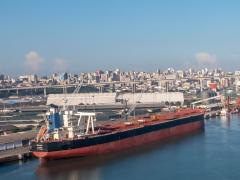
A story carried by FTW quoting a Transnet press release about the newly widened and deepened port entrance at Durban now allowing the handling of 9 200-TEU ships has stirred up what can only be described as a can of worms. Amongst other readers who have been in touch with FTW to question this statement was Rhett van Zyl, MD of CMA CGM Shipping Agencies. He discussed his query with Chris Holton of Bridge Shipping, who, in turn, asked the SA Association of Ship Operators and Agents (Saasoa) if indeed the port could handle this size of ship. As an industry body should, Saasoa immediately posed the question straight to the horse’s mouth – in this case John Hyde and Sidney Bird of Transnet. “Can all the berths handle these vessels?” Saasoa asked. Yes, said John Hyde, as long as it does not exceed the draught limitations. “The beam of the vessels is not really an issue,” he added, “as both Durban container terminal (DCT) and Pier 1 have super post-Panamax cranes which can handle vessels with a 42.2-m beam. “The LOA (length overall) is not really an issue either, as vessels in excess of 300-m can still be accommodated (108/109 is 450-m long, or the vessel could berth across two berths at Pier 1 or on the North or East quays.) “The real restriction for these vessels is the draught alongside, being 11.9-m – and slightly more (12.5-m) with a Transnet National Ports Authority (TNPA) indemnity.” Therefore, Hyde added, in theory a 9 200-TEU vessel could berth at either terminal. “As far as I am aware, a fully laden 9 200-TEU vessel would require a draught between 13.5-m and 14.5-m, depending on the design of the vessel.” And, in receipt of that, Holton told Van Zyl: “This will answer your question. “It can get in – but fully laden cannot berth.” Van Zyl immediately sent FTW a copy of this entire e-mail enquiry. “This man (John Hyde) could play centre for the Sharks,” he said, “as he is able to sidestep anything thrown at him. “But the point is that lines do not put big vessels on the run to sail half-full.”
Transnet clarifies Durban’s big ship berthing capability
Comments | 0
© Now Media. This content is protected by copyright and may not be adapted or republished. If you would like to discuss cooperation opportunities, please contact: editor@freightnews.co.za.