Questions have been raised
over whether Transnet’s
“Youth Development
Programme”, undertaken
by its Maritime School of
Excellence (MSoE), has
delivered on its promises.
The school is
headquartered in the port
city of Durban, with satellite
training centres in Port
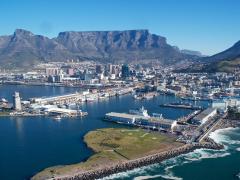
Elizabeth and Cape Town.
School
entrants who
were sold on
the idea of
becoming
fully qualified
seafarers
are now
suggesting
that they may
actually have
been sold a
pup.
The nonprofit-
making
investigative
journalist
team amaBhungane recently
reported that, while the
students had been informed
there were 40 positions
available for training as
general purpose ratings
(GPRs), none had up to now
obtained berths for seatime.
And this appeared
to be not just confined to
the GPR course. It was
understood that cargo
handling trainees had also
had no proper practical
training in the Durban port,
with the current workforce
said to be objecting because
of their concerns about
being replaced by these
trainees.
AmaBhungane added
that the class of 2016
was so dissatisfied that
representatives had sent an
e-mail message to Transnet
CE Siyabonga Gama, laying
out all the complaints
about the programme, and
claiming that Transnet
“has misled us and has sold
us false dreams”. But they
received no response.
Detailed questions sent
to Transnet late last year
by AmaBhungane, and its
claim that school students
were left
twiddling
their
thumbs and
effectively
unemployable
as qualified
ratings,
also went
unaddressed
by Transnet.
All that it
said was
that an
investigation
into
“concerns”
about the school was being
conducted.
In a statement released to
FTW, Transnet said it had
“noted the concerns raised
by some of the learners –
these basically being: Access
to practical training and the
duration of the programme.”
And, it added: “The
company views these in
a serious light and has
instituted an investigation
into the allegations.
The outcomes of the
investigation will be used to
enhance the school’s offering
and will be shared with all
relevant stakeholders once
completed.”
It also said that it had
“confirmed its commitment
to building and
strengthening the country’s
ocean economy” with a
further intake of trainees
for the school; that it had
set aside what it said was
“a record-breaking” R7.7bn
for training over the next
10 years; and that it would
continue with its skills
development drive focusing
on young South Africans.
Transnet also made it
clear in its reply to FTW
that the training provided
did not automatically
entitle a trainee to a job
within the organisation.
“The aim,” it said, “is to
create capacity for Transnet
and industry” – adding
that it armed trainees
“with both the theory and
experience to participate in
the oceans economy” like
shipping lines, cargo owners
and freight forwarders.
However, it added, to date
it had been able to absorb
about 80% of the learners
who had qualified.
But dissatisfied students
in the starting class of
2014 seamanship courses
have been quoted as
claiming that, while they
may have “graduated”
from the school in 2016 as
GPRs, this was only on the
theoretical side. The vital
sea time element, without
which the certificate was
worth nothing, had not
yet transpired, they told
amaBhungane.
A prominent maritime
educational source in the
private sector confirmed to
FTW that most of the points
made in the amaBhungane
report had also
independently circulated in
the maritime training field.
INSERT
Training provided
does not
automatically
entitle a trainee
to a job within the
organisation.
– Transnet
Transnet and students at odds over ‘Youth Development Programme’
Comments | 0
© Now Media. This content is protected by copyright and may not be adapted or republished. If you would like to discuss cooperation opportunities, please contact: editor@freightnews.co.za.