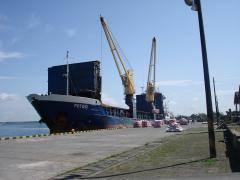
The new tandem lift cranes acquired by Transnet Port Terminals (TPT) don’t mean an automatic boost to productivity at the Durban container terminal, according to two shipping line executives who talked to FTW. These cranes are more complex to use – both for the crane operator and the management of the terminal where they are employed. “Much is required in both training and planning needs,” FTW was told. “It requires a lot of time and effort on how to sweat the assets properly if you are to get a suitable return on your investment.” And one of the executives was not at all sure that TPT would display this ability. “I have some doubts about whether TPT will have enough training and the like to make the best use of them,” he said. “If not, then Transnet has just got something shiny to play with.” Patrick McCarthy of Liftech – who works overseas primarily in project management – was also a supporter of training. Writing for Port Technology, he said: “Proper training and operating instructions are required and need to be clarified in the project technical specifications.” But TPT is confident that it has the necessary wherewithal. Said Hector Danisa, DCT terminal manager: “The terminal has eagerly awaited the arrival of the cranes and has formulated an operational plan to put them to good use as soon as they are fully commissioned by the capital projects team. “As part of the readiness preparations, a group of terminal operations and technical staff have travelled to Shanghai, China, for orientation training. As with all new technology, there will be an initial learning curve before the cranes are operated at ‘full speed’, but we are confident that our crane operators will put these cranes to good use.” Looking at the pros and cons of these cranes, McCarthy said that ZPMC cranes were currently being used in several Asian terminals, and approximately 1 125 tandem-lift cranes were operating around the world. Operator controls are more complicated, he added. The original DHT40 controls were difficult to use and limited production, but new cab and control arrangements seem to have solved this problem. McCarthy also noted that, during DHT40 operation, workers needed to remove more interbox connectors (IBCs). “This requires additional personnel,” he said, “or it would take more than twice as long as for conventional operations. But higher production rates are achievable with cooperation.” DHT40 cranes can significantly increase production, but this depends on equally productive yard operations, he added. “A well-planned yard is essential to achieving the full potential. Productivity simulations depend on accurate dwell times, container layout on ship and in the yard, and other data.” McCarthy felt that possible production could be 60+ container moves per hour, but the operator needs proper training and the yard needs to remove and deliver containers when the crane is ready – which he saw as “a difficult challenge”. However, McCarthy added, a reasonable expected production is at least 40 container moves an hour. This would be almost double TPT’s current crane moves per hour expectations. Initial costs include purchase and related expenses, and are one to two million US dollars above those of a conventional single-hoist crane. Lifetime costs include operation, energy, and maintenance. “Only one operator controls the crane, so operator costs are the same as for a conventional crane,” he said. “If additional workers handle IBCs, this cost increases.” Power costs are higher, but he does not see that as twice that of a conventional crane. “DHT40 cranes present both challenge and opportunity,” he said. “But new DHT40 crane owners will benefit from lessons learned by others.” INSERT ‘A reasonable expected production is at least 40 container moves an hour – double TPT’s current expectations.’ CAPTION The recently arrived new cranes at DCT ... much is required in both traning and planning needs.
Training is critical if new DCT cranes are to improve productivity
Comments | 0
© Now Media. This content is protected by copyright and may not be adapted or republished. If you would like to discuss cooperation opportunities, please contact: editor@freightnews.co.za.