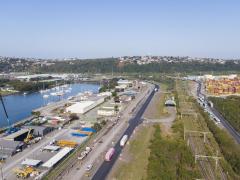
Taking Höegh Autoliners on board as partners provided the spark needed to fire up traffic through Grindrod’s Maputo car terminal, says general manager Pieter Venter. When the vehicle terminal opened in 2007, traffic was slow, and it seemed the sceptics were being proved right. The catalyst proved to be having a shipping line as a partner. Höegh, which purchased a 30% share in the terminal, introduced new services and started using the terminal as a hub for transhipments. Various makes of vehicles are now shipped from manufacturing plants in the East to South East Asia via Maputo. Ro-Ro services up the East coast have also been introduced to transport vehicles into the African market. Maputo now serves Luanda, Lagos and Tema. Other transhipment destinations through Maputo are the Indian Ocean Islands, South East Asia, Oceania and the USA. Volumes of imports of used cars and commercial vehicles for the Mozambican, Botswana, Zambia, Malawi and Zimbabwean markets are also growing. “One of the things we underestimated was the demand for high and heavy vehicles,” says Venter. The terminal had a number of earth movers, truck tractors and big trailers in the yard when FTW visited. The terminal also handles imports and exports for South African original equipment manufacturers (OEMs) and importers. It is now gearing up for OEMs such as Ford and BMW, which are evaluating Maputo as their main point for imports and exports. Nissan already makes use of the terminal. Venter says operations manager Domingo Bie is a Six Sigma expert who was recruited to ensure that the terminal complies with the requirements of potential clients and to manage the operational aspect of the facility. At the same time Venter, who was responsible for the construction of the first phase of the car terminal, is ready to put his hard hat back on again. “Phase two is going to happen a lot quicker than we anticipated, and may start at the beginning of next year,” he says. The design was completed a year and a half ago. It will take the capacity of the terminal from 52 000 to 152 000 vehicles a year. Responding to complaints about high storage costs, he said “we are a car terminal, not a storage depot. The fees are there to encourage people to take their vehicles out as soon as possible. “Storage periods are aligned with customs clearance dwell times and are generous in that regard,” he says. The terminal has an inhouse transit clearing agency to help transit clients speed up the process and to pre-clear the vehicles.
Traffic building up at car terminal
Comments | 0
© Now Media. This content is protected by copyright and may not be adapted or republished. If you would like to discuss cooperation opportunities, please contact: editor@freightnews.co.za.