Weak rand pumps up business opportunities
Growth in Saudi
Arabia, UAE and
Oman, which
have already
experienced a significant
rise in trade over the past
six months, is expected
to continue as the region
prepares for the 2022
Soccer World Cup and
other major events.
President of the Minara
Chamber of Commerce
and international
adviser on the World
Islamic Economic Forum
Foundation, Ebrahim
Patel, said UAE, Oman
and Saudi Arabia had
had seen strong growth
in trade volumes in past
six months – and with
strengthened logistics
links between Durban and
Dubai there were increased
opportunities for South
African companies to
penetrate regional markets.
“Transport, logistics and
infrastructure development
together with consumer
goods are expected to
play an increasing role
in the Middle East (ME)
economy. Major events
such as the Soccer World
Cup in Qatar in 2022
and the World Expo in
Dubai in 2020 will drive
growth opportunities as
these countries gear up for
the events. This will lead
to a rise in tourism and
business activity,” Patel
said.
According to data
released by the Centre for
Economics and Business
Research, Kuwait, Saudi
Arabia, UAE and Oman
would net the biggest
windfalls, with logistics
forecast to contribute
13.6%, 12.1%, 11.7% and
11.7% to their respective
economies by 2018.
“Most ME countries
are spending heavily on
logistics infrastructure
to form efficient supply
chains. Dubai has
positioned itself as the air
logistics hub of the ME
with rapid connectivity
with most of the world,”
Patel said.
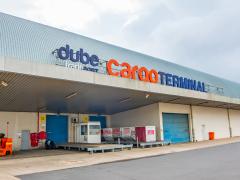
“Direct f lights from
Durban link the Dube
Tradeport with Dubai
making it possible to
freight perishables
overnight. Oman is
developing the ports
of Salalah and Sohar
which will have IDZs
and SEZs located within.
Establishing relationships
between the ports of
Durban, Sohar and
Alexandria in Egypt will
create a strong shipping
route and cover a large part
of the Indian Ocean rim,”
Patel said.
And the newly opened
Ibri/Empty Quarter Road
already linked Oman
directly to the Saudi oil
fields, reducing overland
transport by 500km to
avoid transhipment via
UAE and extra duties, he
said.
Products finding favour
in the region include food
such as chicken from Brazil
and Thailand, meats from
new Zealand and
Australia, fresh fruits
from SA, and snacks from
Malaysia/Indonesia.
“Luxury goods coming
from Italy and Europe and
large MNC (multi-national
corporation) brands are
finding significant traction
in these markets,” he said.
Opportunities for SA
businesses in the region
were in the construction,
technology, financial
services, transport and
healthcare industries, Patel
said.
“Significant projects in
mass rail transport are
in the pipeline for Saudi
Arabia and Oman. Saudi
Arabia will spend
US$1 trillion on transport
infrastructure, building
roads and rail links
between various cities and
provinces,” Patel said.
“Even with falling
crude oil prices, the
recent budget approved
US$168bn for road and
transport infrastructure.
Demand for premium
healthcare and education
facilities continues to
increase,” he said.
Patel added that the
demand for Halaal
products represented
the largest growth
opportunity, with a market
of US$900 billion across
sectors in the region.
“It is the fastest
growing segment
representing US$3trillion
and growing at 20% pa
with a potential consumer
market of 1.8bn across the
globe. Food represents
US$800bn – and for SA
to tap into this will give
a significant boost to
exports,” Patel said.
He added that SA
had made some gains in
exports to the region both
due to demand and the
weakened rand.
“There has been an
increase of over 20% in
reefer export volumes with
fruit making up the bulk.
Corns and maize exports
are growing, even with the
current drought affecting
yields,” he said.
INSERT
Demand for Halaal products presents the largest growth opportunity.