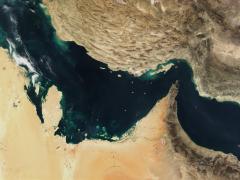
Freight rates through global shipping’s most risk-prone chokepoint stabilised towards the end of last week, but carriers, cargo agents, clients and the wider maritime industry are keeping a close eye on developments at the Strait of Hormuz.
The South African Association of Freight Forwarders (Saaff) reported in its latest Cargo Movement Update (CMU) that rates for 40-foot containers had stabilised at elevated levels – $2 309 per FEU.
Saaff said this reflected market pricing in “ongoing disruption, with rising bunker costs and surcharges underpinning rate floors”.
In the wake of the US announcing it will begin blockading all Iranian ports on Monday, its latest attempt to exert pressure on Tehran after marathon peace talks in Pakistan failed to decisively broker peace in the conflict zone, FEU rates increased immediately.
Marketplace platform Freightos reported that Asia to US East Coast rates were reported at $3 350 per FEU, up 5% week over week.
Asia to US West Coast rates were reported at $2 420 per FEU, up 11% week over week.
A separate Freightos update said carriers had already been applying Gulf-related surcharges, including $3 000 per FEU emergency fees on some cargo bound for the Gulf.
Amid existing uncertainty about the situation around the strait, there seems to be a disconnect between what President Donald Trump is saying and statements issued by US Central Command (Centcom).
Al Jazeera reported that Centcom had said the blockade would apply to “all maritime traffic entering and exiting Iranian ports” from 10am Eastern Time (14:00 GMT) on April 13.
It includes all “vessels of all nations entering or departing Iranian ports and coastal areas”, including those on the Persian Gulf and the Gulf of Oman.
Centcom reportedly added that US forces “will not impede freedom of navigation for vessels transiting the strait to and from non-Iranian ports.”
However, earlier, Trump said, “the blockade would target any and all ships trying to enter or leave the Strait of Hormuz”.
Trying to add clarity, Centcom said the US Navy’s blockade only involved “ships going to or from Iranian ports”.
The price of US crude oil increased 8% to $104.24 a barrel after the US blockade threat. Brent crude oil, the international standard, had increased 7% to $102.29, Al Jazeera reported on the morning of April 13.
This “constrained operating environment”, as reported by Saaff, had resulted in sharp deterioration of carrier profitability, the CMU pointed out.
It signalled a return to pre-pandemic margin pressure despite sustained cost consequences for carriers, filtering down to clients and consumers, Saaff said.
The association confirmed that it had also received information indicating that “Iran is reportedly charging $2 million per vessel”, an unofficial ‘toll’ that is in clear contravention of Unclos, the UN Convention on the Law of the Sea.
At the time the latest CMU was sent out, Saaff said: “Reports have been made that approximately 15–18 ships passed through the Strait of Hormuz in the 24 hours leading up to Wednesday.”
About $36m had apparently been paid by tankers arranging with the government of Tehran to safely transit through the strait.