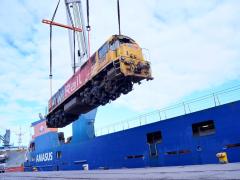
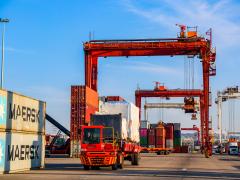
Far away from family and friends many a South African expat has found solace in being able to dip an Ouma Rusk with a pot of home-grown rooibos when the longing for home becomes too much. Finding South African products was, however, not always as easy as it is today. Catering specifically to the retailers overseas who serve the expatriate South African community, South African Products International (Sapro) locally sources and ships tons of goods abroad every month. Thanks to its efforts, home grown delights are at the fingertips of any expat who can’t stand the thought of a curry without Mrs Balls chutney or breakfast without Pronutro, or maybe even a braai (when the weather permits) without good old Iwisa Maize-meal pap. Sapro, for its part, thanks the Durban port from which all its containers are shipped. “Durban is the centre point of our organisation as all our containers are exported from there to our various export destinations – the UK, Ireland, Canada, Australia and New Zealand,” says Audrey McMillan, managing director of Sapro. Having started the operation packing the first container in the parking lot of a major South African retailer, Sapro today exports at least eight 20-foot containers a month, jam-packed with locally manufactured goods for which expats apparently can find no alternative. More than 2000 South African products are in demand and have to be shipped for consumption. “Our initial export market was to the UK, but with time we have grown to supply retailers and wholesalers in Australia, Canada, Ireland and New Zealand. We are also hoping to expand into some of the European countries in the next few months,” says McMillan. “We have never actually advertised our company and we have grown our client base through word of mouth and a very basic website. The number of customers that we have does not grow at a high rate year on year, but our existing customers are ordering more frequently and placing larger orders.” McMillan became involved with the company in 1998 when she and her father were approached to run the South African side of the company after it had been started a year earlier by an English shopkeeper who had converted a part of his shop into a South African corner. With no prior exporting experience McMillan found herself thrown into the deep end. “We set up a joint venture with our clearing agents in the UK who are purely wholesalers and at any one time supply over 200 South African shops, pubs, restaurants and butchers throughout the UK. We initially started sending a handful of products, but over time the price list has grown and we now export over 2000 different products.” McMillan says they have come a long way since the packing of their very first container in a parking lot. “I soon started contacting manufacturers directly and opened accounts to buy direct from them rather than from wholesalers, but this meant we had to find a freight agent with warehouse facilities so all the stock could be delivered to one point. In the early years we packed between two and four containers a month. Today, we ship at least one 40-foot container a week to the UK with a minimum of eight 20-foot containers a month going to other clients. In the busy months we can pack as many as 17 containers for export.” Being 500 kilometres from the port must pose challenges though. “Yes and no,” says McMillan. “From a customs clearing point of view it is better to have the container in Jo’burg should it be stopped for inspection, but from a transport point of view it is slightly more costly again having to haul containers to the port.” And it is all done by road. “We don’t use the rail service any longer because the service is just not reliable in getting our containers to Durban on time. We have therefore had to transfer to road-hauling all our containers which is more costly for our customers.” Most exporters face the same transport challenges though, says McMillan. “The bottom line is that many challenges faced in exporting are around the systems used and that would be the same regardless of where the economic hub is located. “ It is these very systems that pose another great challenge – getting containers from the depot. “Delays are something we have to contend with every day and if there are strikes at the port it is of course much worse. It would be fantastic if the rail system could be improved and the system was one where one did not have to struggle and wait for hours to get containers out.”
The logistics of keeping the expat community happy
Comments | 0
© Now Media. This content is protected by copyright and may not be adapted or republished. If you would like to discuss cooperation opportunities, please contact: editor@freightnews.co.za.