Everyone knows the name of
Henry Ford and the Model T
yet few know the name Malcom
McLean – the father of the greatest
revolution for world trade with his
concept of containers.
A farm kid from North Carolina
in the United States, McLean
entered the road transport business
in 1934 with a single truck which
he rapidly grew to a fleet of five.
Exposed to the time-consuming
efforts of stevedores loading and
unloading cotton bales in 1937, he
began seeking solutions to the time
wasting as his fleet grew into the
fifth largest truck transportation
enterprise in America with 1750
trucks operating out of 37 transport
terminals. Formalisation of road
transportation was being phased
in with several weight restrictions
imposed to avoid overloading, road
damage, safety etc.
He envisaged standard sized
trailers that could be loaded
onto ships in their hundreds.
The trailers could be delivered to
strategically positioned trucking
hubs, making use of trucks only for
short hauls at the beginning and
end of a trip.
McLean sold his trucking
business and, in 1955, took out a
bank loan to create a standardised
shipping trailer, or container. He
bought an established shipping
company, Pan-Atlantic Steamship
Company, which already had
docking rights in many of the
eastern port cities of America he
wanted to target. He renamed it
SeaLand Industries.
McLean went on to test
variations of the container
until he settled on one that was
standardised, strong, stackable,
easy to load/unload and lockable
(which made it theft resistant).
He completed his mission by
purchasing an oil tanker, Ideal
X, and modified it to hold 58
containers and 15 000 tonnes of
petroleum.
On the 26th of April 1956, the
container age was born as the
vessel left the Port of Newark for
Houston. En route, the ship was
already getting advanced bookings
for its return journey, priced 25%
less than its competitors. Apart
from price another particular
attraction was the security that
lockable containers offered.
One year later the first
specifically designed ship for
containers, Gateway City, sailed
from New Jersey to Miami and
incredibly only required two
groups of dockworkers to unload
and load the cargo. They moved
a staggering 30 tons of cargo per
hour which was unheard of at the
time.
Rivals to McLean emerged
with different sized containers,
but he retained the patent of
the revolutionary shipping
container corner posts (vital for
the strength and stacking of the
box). He lifted this patent to
allow for standardisation and
ISO definitions were established
for the terminology, dimensions
and ratings of containers. Then
followed how containers should
be identified – and in 1970 the
recognised sizes of Twenty foot
Equivalent Unit (TEU) and 40ft
shipping containers were cemented.
TEU went on to become the
industry standard for referencing
cargo volume.
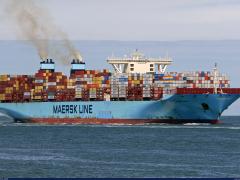
Shanghai... the world’s busiest.