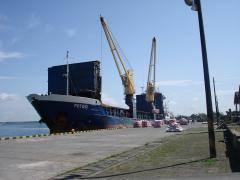
JOY ORLEK DECISIVE ACTION to improve throughput at South Africa’s ports is crucial to stem the flow of cargo to our southern African neighbours who are already making significant gains at local expense. A combination of factors, all of which boil down to cost and efficiency, is steering shippers towards the likes of Dar es Salaam, Maputo and Walvis Bay, a trend that has been gaining momentum over the past 12-18 months. While these are often nameless statistics, UK-based African Cargo Services spelt out some of the practical reasons why it has switched much of its Far East-bound cargo from Durban to Dar es Salaam. And it’s a development that should serve as a wake-up call for SA Port Operations. The company’s core business starts in Zambia and the DRC, moving copper and other base metals either through Dar es Salaam or Durban on the southern route. Its primary market is the Far East followed closely by the Middle East. “In the past Far East-bound traffic has moved exclusively through Durban,” UK-based operations manager Paul Vickers told FTW in London recently. But this is increasingly being rerouted via Dar es Salaam for a variety of reasons. “From Dar all the costs are dollar denominated – road and rail transport as well as port charges - whereas in South Africa the exchange rate risk comes to the fore “We have to lock in with our client on a 12 month contract basis from January 1 to December 31, and no-one can really predict what will happen to the rand. “We take the precaution of hedging with our bank but there is a cost attached to that which has to be taken into account.” Another problem relates to the timing of the port and Spoornet rate increases. “These are announced in April, but since our annual contract with metal traders begins in January, we have to speculate as to what the increase is likely to be. It may be as little as 8%, but it could also be as high as 20%, which scares us and the producers.” According to Vickers, for 2005 it’s 15% more expensive to move copper to Johannesburg or Durban than to Dar es Salaam, not taking into account the April increases. Add to this the Durban congestion surcharge and the fact that ocean freight rates from Dar have now dropped to a level where they are competitive with SA freight rates, and the Dar option begins to make a lot of sense. “When the congestion surcharge was first introduced we were told it was a temporary measure. Eighteen months later it’s still quoted for 2005 with little hope of it being withdrawn. And from a metal producer’s point of view, $100 per 20 foot container translates into $5 a ton which he would far rather add to his profits.” Destinations that were in the past always served through SA, be it Durban or Port Elizabeth, because it suited the rate level, are now being pushed to Dar. “A lot of China, for example, is more cost effective from Dar,” said Vickers. The Middle East and Indian subcontinent are the traditional markets served from the Tanzanian port. But Vickers makes it clear that Durban will never be totally eclipsed. “We rarely have problems there and it generally works well. We will however continue to keep an eye on the rand/dollar exchange rate and where necessary cargo will be switched to Dar.”
Stronger rand and congestion surcharge steer Durban cargo to Dar es Salaam
Comments | 0
© Now Media. This content is protected by copyright and may not be adapted or republished. If you would like to discuss cooperation opportunities, please contact: editor@freightnews.co.za.