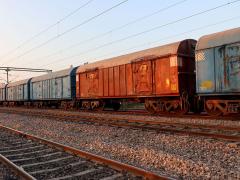
As the fuel industry strike enters its second week, the fuel-thirsty road transport industry is under threat. At FTW’s date of print (Monday, July 18), Gavin Kelly, technical and operations manager of the Road Freight Association (RFA), painted a gloomy picture. The major road hauliers were mostly OK, he told FTW. They have their own fuel tanks, and most have 14 days or upwards of fuel in reserve. But even this section, about a third of the industry, could be facing a crisis. An executive of one of the country’s big trucking concerns agreed. “We were proactive,” he said, “and filled up our tanks before the start of the strike.” And, he added, although a lot of Gauteng filling stations had cones up, marking a lack of fuel, and those others with fuel had long queues hoping for a fill up, there were still deliveries taking place. But Running on empty ... small trucking companies on the critical list. even that had reached a worrying stage. “A lot of the fuel suppliers have their own tanker fleets,” our big trucker contact told us on Monday, “but they have their own private security operations as well as the police escorting the tankers to their destinations.” Photo: Shannon Hill. He also agreed that intimidation was escalating, and at least one driver having been shot didn’t bode well for the drivers’ willingness to make deliveries. “If the strike continues during the course of this second week,” he said, “things will become critical for us.” The industry’s 30%+ of medium-size trucking companies, meantime, are in a more tricky state. Their reserves of fuel are less, and they have only a few days’ supplies of diesel on hand. Said Paul Rayner, MD of DTB Cartage, one of the short-haul container carriers: “From a company point of view, we filled our tanks before the strike.” But, he added, speaking on Friday, July 15: “In the next five days, if we get no deliveries, we could be in trouble. And there could be a number of other companies in a worse state than us.” Kevin Martin, MD of Freightliner, and chairman of the Durban Harbour Carriers’ Association (DHCA), said: “It has become very tight.” Again speaking last Friday, he told FTW that his company was hoping for a fuel drop that day. “That would be about two days of reserves,” he added, “And we’re also hoping for another drop tomorrow. “We get diesel direct from the refinery. They have mid-September, as soon as the initial service is consolidated,” Manzoni told FTW. The vessel on the trade will be the own-geared UAL Cyprus, a multi-purpose vessel capable of carrying breakbulk, out-of-gauge project cargo, heavy lift and containers. The service is designed stock, but I don’t know how much. But, they foresaw the problem, so we’re hoping there may be some available.” But the small companies – those one-man and one-or- two-truck operations – are already on the critical list. Kelly told us that they comprised the remaining third of the industry. “They get their supplies of diesel direct from the filling stations’ forecourts,” he added. “But whether they can get supplies is another matter, particularly in Gauteng where fuel is noticeably short.” The first of this week’s to extend the connecting services from the US, West Africa and SA into the East African markets, and will focus on the line’s niche market in the oil and gas industry. “The strategy is to return the vessel back into Durban, Cape Town and onto West Africa, subject to cargo levels,” Manzoni added. meetings between the fuel company employers and the unions was being held on Monday, and the trucking industry had its fingers tightly crossed that things would get closer to settlement. FTW has painted a worst- case scenario, but the truth of the matter is that – if settlement isn’t reached, and fuel refineries can’t get back into a two-three-day restart procedure – then the trucking industry, and the SA economy that it serves, could be grinding to a not-so-slow stop by the July 22 date of issue of this publication.
Strike fuels fears of economic slowdown
Comments | 0
© Now Media. This content is protected by copyright and may not be adapted or republished. If you would like to discuss cooperation opportunities, please contact: editor@freightnews.co.za.