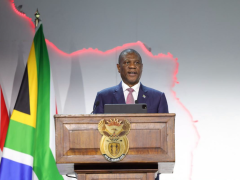
The possibility of a roll-over agreement between SA and the United Kingdom before March 29 has come and gone. Whilst all efforts have been made under the leadership of Botswana, which is heading up the negotiations for the South African Customs Union (Sacu) and Mozambique, to come to some form of an agreement before the Brexit deadline of March 29, the UK has played hardball over the issue
of cumulation – one of two unresolved matters on the table. According to Minister of Trade and Industry Dr Rob Davies, the UK has called for full cumulation – a mechanism that allows you to consider non-originating materials used or processing carried out in another country as originating in your country or carried out in your country. With no intention of backing down on the demand, the UK has called
it a “red line” in their negotiations. Sacu plus Mozambique cannot agree to full cumulation because of a clause in the Economic Partnership Agreement (EPA) with the EU that states that anything better offered to another country must equally be extended to the EU. Full cumulation to the UK would essentially mean it was being treated more favourably than the EU. “The EU, in turn, have said they cannot discuss
cumulation until such time as there is certainty on how the UK will leave the EU,” said Davies. “We then asked the UK for a roll-over of the provisions of the EPA on this matter, but in our last meeting they told us that full cumulation was a red line for them. They are not budging from that position.” The second unresolved issue, said Davies, related to sanitary and phytosanitary (SPS) measures. According to the EPA, agricultural exports have to
meet stringent requirements to ensure SPS certificates are issued. While the UK has agreed that the SPS certificates will still apply to Sacu plus Mozambique, the timeline until renewal has come under the spotlight – as has the renewal. According to Davies there was no clarity as to how long the certificates would apply. “They have also stated that these certificates will only be renewed on reasonable grounds. We have said that if there is an outbreak of a disease or someone is not complying, then sure, but what exactly are the terms and conditions that make up reasonable grounds,” said Davies. In the absence of any further clarity, Sacu plus Mozambique could not agree to the reasonable grounds clause he said. “We are very aware of the uncertainties and concerns that exist with trade around Brexit and we have been preparing for this as much as we can using the EPA as a template,” said Davies. “On many of the issues the negotiations went well with the understanding that for the most part we will just be rolling over the EPA until the UK is formally out of the EU after which we will have a rendezvous and draw up new agreements.” But, said Davies, the two unresolved issues were by no
means small matters. He said South Africa was preparing for all eventualities regardless of whether an agreement was reached or not. “The fact remains that we do need some kind of arrangement in place at some stage. If there is a formal withdrawal from the EU with a deal then we can sit back and see what the terms are between the UK and EU and have the time to then finalise our own deal.” Davies said it was near impossible to quantify the impact of the UK leaving the EU in a disorderly fashion, but if that was the case South Africa would deal with the issue as best it could. “In the interim we continue to negotiate and deal with this situation that is not of our making in such a way that we best preserve our relationship with the UK and our relationship with the EU.”
IMAGE WITH CAPTION:
Sacu plus Mozambique cannot agree to full cumulation because of a clause in the Economic Partnership Agreement with the EU. – Rob Davies