Increased costs remain
a major concern for
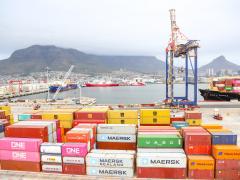
Cape Town traders
whose containers are
being stopped for inspection
through the cargo scanner at
the port.
Whilst the state-of-theart
machine was supposed
to ensure a faster and
more effective inspection
all round while also being
far less intrusive a search
method, industry claims
the exact opposite is being
achieved.
“Costs are skyrocketing,”
said a source. “Scanning one
container can cost as much
as R14 000. The old system
was far cheaper while the
efficiency of the new system
is also questionable.”
He said not only were
containers being stopped
for scanning but they were
then immediately searched
physically afterwards and
then only released.
“We might as well go
back to the old system of
only physical searches,” said
another source. “The average
cost for a container being
scanned is now in the region
of around R10 000 per
container.”
This is due to increased
handling fees as well as
rates charged by shipping
lines that are responsible
for the movement of the
containers to and from the
scanner. Even if containers
are released at the scanner
they are still on the shipping
line vehicle and then have to
be moved to a depot where
they are transferred to the
trader’s transport of choice.
All of this has increased
costs dramatically.
Industry has called on
Transnet Port Terminals
(TPT) to move containers to
and from the scanner which
is situated within the Cape
Town terminal.
“There has yet to be
any decision made in this
regard,” said the source.
“In principle there are no
objections to the scanner
and the way it operates. It
simply is costing a fortune
and it’s a cost importers can
hardly carry in the current
economic environment.”
'Scanning costs skyrocketing at Port of Cape Town' - importers
Comments | 0
© Now Media. This content is protected by copyright and may not be adapted or republished. If you would like to discuss cooperation opportunities, please contact: editor@freightnews.co.za.