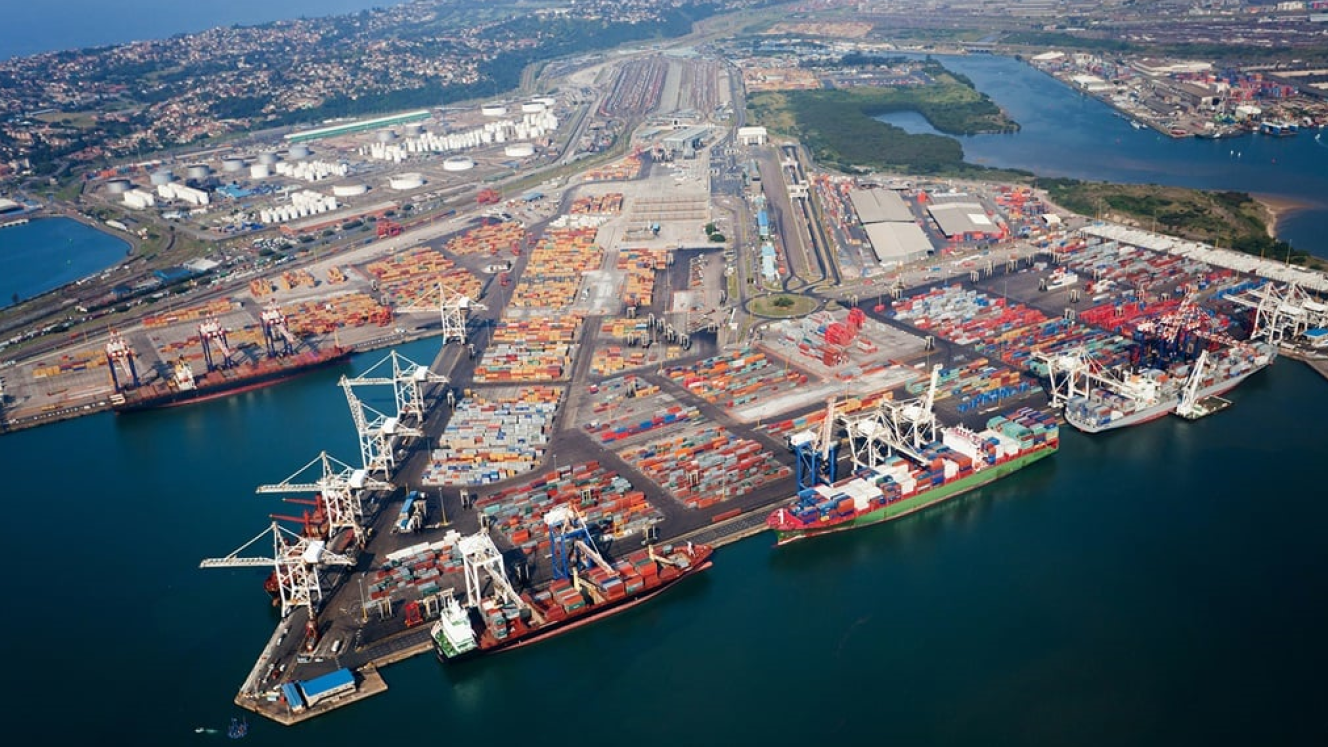
Industry clarity is essential on how the public-private partnership (PPP) at Durban port’s Pier 2 container terminal will interface with wider network enablers, says Dr Juanita Maree, chief executive of the Southern African Association of Freight Forwarders (Saaff).
This was her message in a media statement after Wednesday’s official signing into operation of the deal that will see International Container Terminal Services Incorporated assume control of 49% of South Africa’s busiest box pier for a period of 25 years.
Clarity on interfacing, Maree stresses, includes rail slot allocation, border and customs coordination, digital integration, and the alignment of terminal operations with the Gauteng hub and regional trade corridors.
“Given Pier 2’s role as the country’s primary gateway, transparency on how risk is distributed between ‘NewCo’ – the PPP company launched to oversee the concession – and Transnet across marine, quayside and landside functions will be critical.”
A concession of this scale must not only optimise terminal performance – it must support end-to-end velocity across the national logistics chain, involving all concession partners, Transnet Port Terminals, Transnet National Ports Authority, and NewCo.
“It is essential that this partnership must stand as a benchmark for excellence in public–private collaboration – grounded in openness, shared accountability and unambiguous integrity,” Maree says.
“Only through transparent governance and unified commitment to reform can South Africa convert this development into durable competitiveness to elevate its logistics system into a new era of performance.”
Maree adds that looking ahead, “Saaff emphasises that long-term competitiveness of South Africa’s logistics system will depend on embracing both inter-port and intra-port competition as principal strategic levers of performance.
“Competitive pressure is the most effective catalyst for accelerated performance, and Transnet has, in recent times, given strong focus to best practice in this arena.”
She emphasises that a competitive port environment stimulates innovation, disciplines costs and raises service standards – ensuring that no terminal, operator or corridor is insulated from accountability and enforcing transparency.
Given all the negative media attention that the country’s underperforming ports and crumbling rail freight sector has attracted, it stands to reason that there’s now a real opportunity to claw back lost logistics credibility on the international stage, Maree points out.
“For South Africa to regain its position as a leading trade and logistics hub, competition must be embedded as a strategic principle across all ports and terminals.
“This is the pathway, not just to accelerated performance, but to organically boost sustained investment and a logistics system capable of supporting national growth and continental leadership for South Africa.”
Given the significance of this moment and what is at stake for South Africa following Wednesday’s historic PPP deal, Saaff has issued a challenge to the operator and all governance structures involved.
“The credibility of this partnership will depend on transparency, measurable delivery and uncompromising accountability.
“The national imperatives must guide all planning and be rigorously enforced across socioeconomic and environmental dimensions. A systematic transfer of skills throughout the concession period, together with robust and verifiable employment creation and employment creation alongside localisation programmes, must remain non-negotiable outcomes.”