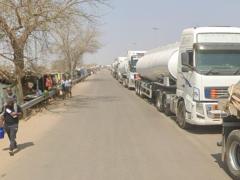
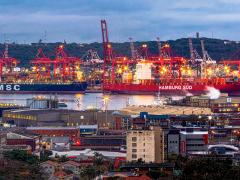
Statistical evidence was at odds with the reality on the ground when South Africa’s port tariffs came under the spotlight at the Transport Forum in Durban recently. Transnet Port Terminals senior manager strategy, Willie Coetsee, challenged the long-held assertion that SA port tariffs were among the highest in the world. “This is simply not the case,” he told delegates. “What is true is that it is fairly expensive to do business from South Africa due to the distance from international markets. “Total supply chain cost includes the cost of documentation, customs, road transport and sea transport. The cost of transport – both on land and at sea – outweighs port costs by far,” he told delegates. Transnet’s port charges contributed only 15.6% of total supply chain costs, he said. And making global comparisons, he pointed out that Terminal Handling Charges (THC) levied by TPT were 35% less than THCs charged on average by the majority of international terminal operators. “Total port charges from TNPA and TPT combined are 12% lower than the average charged by other ports across the world,” he added. According to Coetsee, the “undue criticism” of Transnet’s tariffs followed a report issued by the Ports Regulator in 2010 which he believes was quoted out of context and where there was over-emphasis on the prices that were higher than global averages while those lower than global averages were ignored. He provided several examples to illustrate his point. According to data published on the website of shipping line Hamburg Süd, the terminal handling costs in Durban are among the lowest in the world. The comparison shows that Durban terminal handling charges are the seventh lowest in the world of all the ports serviced by the shipping line. And looking at total port and handling costs relative to total supply chain costs, South Africa resides on the lower average, he said. It is expensive to trade with South Africa, but port costs are not the largest component of the total supply chain costs, he added. Transnet’s costs, he said, contribute only around 15.6% to total supply chain cost. Based on a World Bank calculation that includes all fees charged by government agencies and the private sector to a trader in the process of exporting/ importing goods, the charge for completion of documentation (19.4%) is more than what Transnet charges for bringing a ship into port, off-loading its contents, storing it for three days and loading it on a train or truck for transport, he said. But it’s not only about statistics, said SA Association of Shipww w Operators and Agents CEO Peter Besnard. “The data needs to be linked to productivity,” said Besnard, whose sentiments were shared by Freightliner MD Kevin Martin. “While I agree with a lot of what Coetsee said, his figures do not include wasted cost due to delays,” said Martin. “Our present road f leet servicing the port – which is doing approximately 2.8 million boxes a year (inclusive of transhipments) – could service a port doing 7.5 million boxes without an increase in that f leet. This could be achieved by working smarter and fully utilising land assets presently under the control of the parent company. These are currently either under-utilised or Transnet has chosen to rent to third parties to the detriment of the country but not the Transnet bottom line.” In Martin’s view, this over-supply of road vehicles – due to terminal delays in the main – further affects back-of-port facilities ie, roadways/warehouses and staffing, with a potential reduction in local transport of up to 40% a distinct possibility. And that is what Transnet is wasting and not showing,” he said. “All of this impacts on the cost of our logistics chain but not in Transnet figures – which is like moving the chairs around on the Titanic whilst ignoring the icebergs!” INSERT Port charges just 15% of export costs According to a World Bank report on trading across borders, only $285 of the $1 830 it costs to export a twenty foot container from South Africa is related to the port authority’s fees and terminal operators’ terminal handling charges combined. “No single port charge can be accurately compared purely by its name, but the World Bank’s report is generally accepted as a standard across the world, comparing the cost of exporting a single container from a country's economic hub to its major port,” Transnet's Willie Coetsee said.
SA port costs about a lot more than statistics
Comments | 0
© Now Media. This content is protected by copyright and may not be adapted or republished. If you would like to discuss cooperation opportunities, please contact: editor@freightnews.co.za.