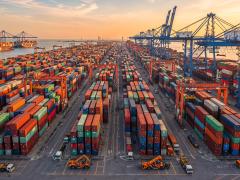
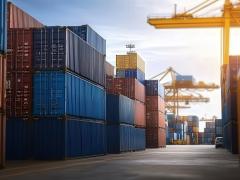
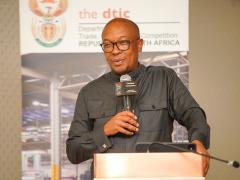
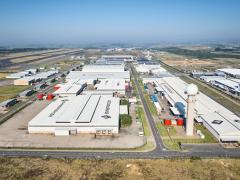
Transport heavyweights last week renewed their call for South Africa to become a maritime nation in order to compete on the global trade stage and take advantage of the opportunities offered by international trade route changes. Of the R84 billion spent on maritime import and export trade last year, R44bn was spent on freight costs which went directly into foreignowned maritime coffers. This is money which could contribute to South Africa’s gross domestic product (GDP) growth and is thus a major incentive to develop the country’s maritime assets, speakers at the monthly Transport Special Interest Group (SIG) Forum in Johannesburg said. Deputy minister of transport, Sindiswe Chikunga, noted that while the maritime sector was widely recognised as a major contributor to trade growth – 80% of South African trade is conducted through the country’s seven ports – it has for too long remained an unspoken part of the transport sector. “This has changed and government recognises that the maritime sector has a powerful voice and is working on creating an enabling environment to attract investment and spur development,” she noted. Chikunga said that initiatives to develop the sector and up South Africa’s competitiveness as a maritime nation should include South Africa building, maintaining and sailing its own fleet of commercial ships and the establishment of a South African Ship's Register which needs to be benchmarked against “the best global operators”. She noted that government had been working to improve investors confidence in the viability of the maritime sector by introducing a new tax regime, creating an improved mortgage rating which facilitated ease of financing, and working with the International Maritime Organisation (IMO) to ensure South Africa’s maritime labour laws were managed and regulated under international shipping laws. “We are also looking at establishing a dedicated maritime training facility to address the severe skills shortage across a variety of core competencies,” said Chikunga. Professor Johan du Plessis, managing director of Logistics International SA, said that South Africa’s ports were key assets and vital gateways for maritime trade. But, he said, they were under threat from competing African ports that were investing heavily in expansion, new ports and supporting infrastructure such as road and rail to and from the ports. “To remain a trade gateway into Africa and the rest of the world, the ports need to retain and up their efficiencies,” he said. Du Plessis added that the port developments in and around Durban would provide much-needed capacity and efficiency but that the timing around completion of these projects was quite sensitive. “South Africa cannot afford to miss the boat and lose out to its regional competitors,” he noted. Commander Tsietsi Mokhele, CEO of the South African Maritime Safety Authority (Samsa) made mention of the high percentage of free on board (FOB) contracts. “At the moment we are giving complete control to foreign freight players and losing opportunities in the process.” He noted that the market would soon be closed to foreign cabotage and placed in the hands of South African operators. “Although government needs to create the enabling environment, it is up to South African owners and operators to drive the changes and ensure strong global competitiveness,” said Mokhele. INSERT & CAPTION Government recognises that the maritime sector has a powerful voice. – Sindiswe Chikunga CAPTION The Port of Cape Town, along with SA's other ports, is a vital part of maritime development.
SA gets aggressive on maritime development
Comments | 0
© Now Media. This content is protected by copyright and may not be adapted or republished. If you would like to discuss cooperation opportunities, please contact: editor@freightnews.co.za.