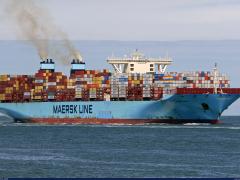
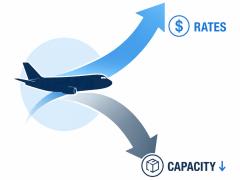
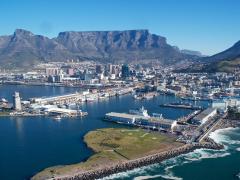
With larger capacity ships calling in SA, and even more due to be coming on line, the major concern at the moment is whether our ports will be able to handle them. No need to worry, Iain McIntosh, regional sales manager of MOL, told FTW. “It’s been going on for five years now,” he said, “and it’s no different now – only the ships are even bigger.” And the reason for their arrival, McIntosh added, is because the mega-ships of 14 000-18 000 TEU capacity are now the norm on the Asia- Europe route. Quoting the latest Alphaliner report, he said that no less than 33 units over 10 000 TEU were delivered (a total capacity of 442 000 TEUs). This was led by the delivery of the 18 200-TEU Maersk McKinney Moller last month, joining other Maersk vessels and the three CMA CGM ships, the Marco Polo, Jacques Cartier and the Alexander von Humboldt, all of about 16 000 TEU capacity. But the stagnant demand on the FE-Europe route, McIntosh added, led carriers to remove an equal amount of capacity from the trade. “As Alphaliner pointed out,” he said, “this has led to re-assigning smaller units to other trades and triggering a wave of vessel cascading across multiple trade lanes.” In percentage terms, according to Alphaliner, the Africa- and Oceania-related trades saw the largest capacity increases – of 14.5% and 15.1% respectively. “On the African trades, a total of 185 000 TEUs of capacity has been added, part of which we are now seeing calling at the SA ports of Durban and Ngqura,” McIntosh added. For example, now calling at the Port of Durban is the largest containership ever to call at an SA port – the 12 562- TEU MSC Fabiola. She took over the Durban record from the 11 660-TEU MSC Luciana, both on the line’s Pendulum service. And MSC SA’s marketing director, Glenn Delve, told FTW we would see some more of MSC’s 12 500-14 000- TEU superships joining the Pendulum fleet soon. These, he added, are cascading down from the main trades of Asia- Europe and the transPacific from Asia to the US. The problem with these post- Panamax ships is their draught fully laden. In the case of the Fabiola, this is 15.5 metres. And the only SA port that can take them at the moment is the deep-water harbour at Ngqura. However, Durban will soon follow. Although the port entrance channel has a depth of 19m, decreasing to 16.5m inside the entrance, the berths are currently restricted to a depth of 12.8m. This means that any of these large ships have to sail in and out lightly loaded, which is seen by industry observers as reducing the vessels’ economy. But the work currently being done on the berths at Pier 2, where the Durban container terminal (DCT) is sited, includes a deepening of the berths to 16.5m – enough to take mega-ships fully loaded. As to the question of what do these large ships mean for freight rates, McIntosh again turned to the latest Alphaliner report. On the Asia-Europe main trade, average container rates from China – measured by the China Containerised Freight Index (CCFI) – are down 18% compared to the same time last year as the influx of new capacity continues to put pressure on freight rates. “The rate weakness has spread from the FE-Europe trades, as vessel cascading has brought capacity additions to secondary trade lanes,” it added, as the influx of new capacity continues to put pressure on freight rates. To confirm whether this is also true on the SA trades, FTW spoke to Werner Jacobs, marketing analyst at MOL. He noted that the larger vessels combined with the approaching move into the full pre-Christmas peak season was having an effect. “It’s definitely a softer market at the moment," he said. CAPTION When the 11 660-TEU MSC Sola arrived in South African waters a year ago, she was the biggest ever vessel to call at an SA port. She has now been eclipsed by the 12 562-TEU MSC Fabiol.
SA feels impact of big-ship extravaganza
Comments | 0
© Now Media. This content is protected by copyright and may not be adapted or republished. If you would like to discuss cooperation opportunities, please contact: editor@freightnews.co.za.