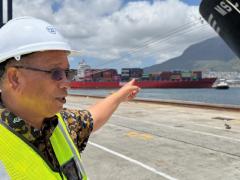
South African companies are starting to move out of their comfort zone and join the scramble for the rest of Africa – with many recognising the opportunity and potential of West Africa, says trade consultant at Whitehouse & Associates, Duncan Bonnett. “For many years a lot of South African companies have concentrated on the SADC region and East Africa. And while there is a greater level of comfort in doing business in southern and East Africa, once that’s bedded down West Africa is the logical next step. Already we’re beginning to see the likes of Shoprite expanding on their stores in Nigeria, so we will start to see growth.” Nigeria is the centre of the region with by far the largest economy, says Bonnett. “And despite the problems in the north it’s on a good growth trajectory.” While many of the opportunities still lie in the oil and gas industry and services around that, there are increasing opportunities in the fields of agro-industry, solid minerals, telecommunications, construction, retail, banking, fast foods and franchising. “All of these are starting to see a lot more activity.” And while a number of South African companies are moving into the market, there are not enough, says Bonnett – no more than around 100 in his estimation. “The popular perception among South Africans is that there’s nothing there other than oil and gas – which is selling Nigeria short. They have a well-established financial services centre and a well-established telecoms industry, and we’re competing against Nigerian manufacturers of industrial products, food processing and pharmaceuticals that are sometimes three or four times the size of SA manufacturers, in the case of cement players “And not only are we competing against local players, but also against European, Asian and Latin American countries. Chinese companies are setting up cell phone and motorbike assembly plants while some of the big power companies are setting up manufacturing units in Nigeria. It’s a very dynamic market offering opportunities on a scale that we don’t see in South Africa.” The market is not, however, without its challenges. “The ports are better than they used to be and it’s not a cheap market – but if you can overcome the challenges, it can be very lucrative.” Another key market in the region, from an SA perspective, is Ghana. “For the past decade it’s experienced a mining boom – especially gold mining - which has underpinned a lot of the growth. But now there’s the oil boom which is set to move things to a new level. It’s been under way for a year or two, but we’re now starting to see a move from exploration to production and there’s a lot more intensity in engagement in infrastructure – not only for mining but in housing and retail development. As expats and professionals move into those areas down the coast, there’s a large concentration of relative wealth and demand for goods and services.” And while a lot of development was previously poorly planned - or unplanned – this has now improved, providing opportunities for architects, quantity surveyors and the like. “Some South African companies have been involved from the start – from architects who have designed shopping malls to some of our banks that have been active in Ghana for a few years – but there should be more South Africans involved in the supply of goods and services.” While Nigeria and Ghana are the big markets, Bonnett believes a number of other West African countries offer significant opportunities. “Cote d’Ivoire, as it tries to extricate itself from problems of instability, will bounce back and is an important economy in the region. From an SA perspective it’s a market that we haven’t explored much at all. “In Liberia, Sierra Leone and Guinea there is a developing iron ore complex which is playing out quite slowly. They have marooned resources because they have fantastic deposits of minerals but no infrastructure to get them to the coast. There’s a lot of politics at play as they decide where the rail and ports should be, but while some mining companies have walked away, others are quite bullish.” Mali is a no-go area for now, but Senegal is a market to consider – although from an SA perspective it’s quite far away and closer to Europe and North Africa. “But it still offers a lot of opportunity in terms of downstream agricultural processing. On the negative side, it’s still quite an unstable area in terms of what’s happening in places like Mali, north of Nigeria and Niger, so you need to be careful when you look at those countries.” Infrastructure issues, says Bonnett, are not a lot different from infrastructure deficits in the rest of Africa. There are plans to link coastal highways through Ghana to Cote d’Ivoire and the creation of regional oil and gas infrastructure is slowly coming to fruition. “The West Africa of 10 years ago is very different in terms of infrastructure development. “Countries are slowly getting their acts together and we’re seeing improvements – albeit off a low base.” INSERT & CAPTION Nigeria’s ports are better than they used to be but it’s not a cheap market. – Duncan Bonnett Mali A no go area for now. Senegal A lot of opportunity in downstream agricultural processing. NIGERIA Despite the problems in the north it’s on a good growth trajectory. GHANA Now there’s the oil boom which is set to move things to a new level. Cote d’Ivoire Will bounce back and is an important economy in the region. Liberia Guinea Sierra Leone There is a developing iron ore complex.
SA companies join the scramble for West Africa
Comments | 0
© Now Media. This content is protected by copyright and may not be adapted or republished. If you would like to discuss cooperation opportunities, please contact: editor@freightnews.co.za.