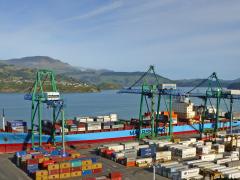
Statistics released recently by the United Nations Conference on Trade and Development (Unctad) show that containerisation is continuing to gather steam – with containerisation rapidly replacing the traditional reefer vessels. “Since 2001, hardly any new capacity has been added to the fleet. Most ships that are currently trading were built in the 1980s and early 1990s,” says the Unctad report. A large proportion of the ships older than 25 years have been scrapped during 2009, and scrapping activity can be expected to increase in coming years. For the reefer cargo exporting countries of Asia, Africa and Latin America, the “development of container terminals will increasingly have to cater for the corresponding reefer container facilities,” it says. Another trend is the growing size of the container vessels. Since 2004, when Unctad first generated the LSCI, the average of the maximum vessel size per country has continuously increased. In July 2010, it was 65% higher than in July 2004. The largest containerships in service today are 14 770 TEU ships operated by Maersk, which are deployed on services between Asia and Europe, including a call at Morocco. As the largest vessels are deployed on the main eastwest routes, other vessels are redeployed on north-south and regional routes, pushing up the average. In 77 countries, the largest ship in July 2010 was larger than the largest ship in 2009; in 43 countries the vessel size has remained unchanged; and in 42 countries, the largest vessel deployed in 2010 is smaller than the largest vessels that provided services one year earlier. Algeria, Jamaica and Morocco are among the countries that have recorded the largest growth in container ship sizes servicing their ports, says the report. The number of companies providing services has however decreased. The average number of companies per country is 17.6 in 2010, against 21.8 in 2004, a decline of 20%. “Mergers and acquisitions thus lead to lower levels of competition, which is of particular concern to countries with lower trade volumes,” says the report. The long-term picture as regards the global liner shipping network appears to be mixed. On the positive side, larger ships and a higher total TEU carrying capacity can cater for the growing global trade in manufactured goods, and economies of scale help to reduce costs. On the other hand, the larger ships also pose a challenge to smaller ports as regards the necessary investments in infrastructure. The network as such is not expanding in terms of companies or services. “The trend seems to be towards lower costs but also towards less choice for shippers,” says the report.
Report reveals trend to lower costs – and less choice for shippers
Comments | 0
© Now Media. This content is protected by copyright and may not be adapted or republished. If you would like to discuss cooperation opportunities, please contact: editor@freightnews.co.za.