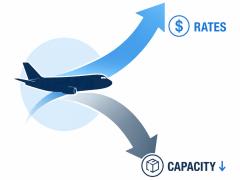
Growth in the South African airfreight industry will be driven by regional integration in the SADC region in particular, in the view of Hannah Edinger of Frontier Advisory. This comes as South Africa, specifically OR Tambo International, plays a significant role as the regional hub for goods that are landed from abroad, and then further distributed into SADC in particular,” Edinger said. In addition, the SA Express Parcels Association foresees the impact of the cost of e-tolls, deteriorating road infrastructure and the everpresent threats of hijacking as challenges that may presently weigh heavily on the local road freight option. “It would not be surprising to see some commodities returning to the high-speed, high-security air sector,” said Saepa CEO Garry Marshall. Mainstay cargo categories transported by express freight across SA and into Africa presently include urgent machinery, vehicle and aircraft spares as well as consumer electronics. However, Marshall said the express airfreight sector was not without its challenges, such as the stringent international cargo security regulations, which have transformed the industry. “They affect personnel, equipment and procedures and impact on all parties in the chain, from supplier via service-provider and carrier to consignee. SA is a signatory to international bodies and compliance is mandatory,” Marshall said. He added that this required intensive education at all staff levels within the industry and the association was assisting by putting staff through a newly developed Certificate in Supply Chain Management. “A compartmentalised view of express logistics, focusing solely on the transport leg, is not enough. Staff need a wider perspective and understanding of customer business models,” Marshall said. According to Saepa the technological revolution has continued to impact the industry, forcing service providers to constantly keep abreast of new developments. Typical technological advances have included: • Ordering through on-line channels, short-circuiting traditional order and re-order patterns • Greater automation in the acceptance and routing of packages • On-line signatures – proof of delivery • Satellite tracking for greater vehicle efficiency and security Saepa foresees that the industry will evolve to include a greater number of industryspecific service providers with specialised equipment, procedures and staff. For example, cool-chain service providers for extreme timeperishables ranging from medication to foodstuffs to high-fashion items. “It’s a young industry – the first 40 years have already been remarkable. With the explosion of technology, the next ten will be staggering,” Marshall said. INSERT 1 Challenges of delivering on-line purchases · In addition to durables, groceries are becoming a mainstream on-line purchase and they require a different set of skills due to perishables and the frequency of purchases. · In SA suburban deliveries can be problematic because unlike industrial parks, often no-one is home during the day. · It is expensive to drop off one consignment at a time. · Many people live in secure complexes where door - to-door delivery is impossible. · `Many impulse buyers focus on the purchase price of the item, without realising that customs duty and clearance, VAT and other charges may be levied, resulting in a surprise at point of delivery. INSERT 2 Convenience of online purchasing · Consumers don’t have to waste precious working or leisure hours travelling to various stores and malls to compare prices. · They can buy at any time day or night without waiting for shops to open. · The express freight industry fulfils the order conveniently by delivering to home or office.
Regional intergration will drive airfreight growth
Comments | 0
© Now Media. This content is protected by copyright and may not be adapted or republished. If you would like to discuss cooperation opportunities, please contact: editor@freightnews.co.za.