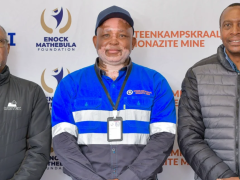
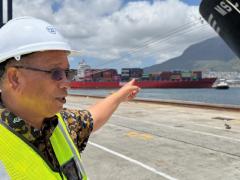
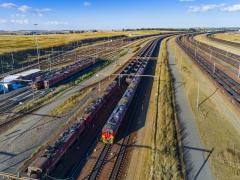
Southern African efforts to create a more integrated infrastructure between countries took a step forward with the signing of a memorandum of understanding (MoU) by Transnet and Swazi Rail. The two countries’ governments signed an MoU in August to officially mark the start of the cooperation between the countries in setting up a greenfield R17- billion cross-border rail link. “We have the commitment between the two governments, and the signing of the MoU between the railways is due to happen now,” Cleopatra Shiceka, general manager at the CEO’s office of Transnet, told FTW. African countries could benefit hugely from functional cross-border rail links that would enable an easier flow of goods and services, breaking down trade barriers that are currently hampering countries across the continent. “We [South Africa] import all of our oil from Brazil, instead of just driving it across the border from Angola,” a mining consultant told FTW. “Why is this? Because we physically can’t drive it across the border. It is cheaper for us to ship it all the way from Brazil.” “Development of infrastructure will help reposition African economies and alter the patterns of change with the developed markets,” Malusi Gigaba, public enterprises minister, said in January about the new proposed cross-border rail link between South Africa and Swaziland. Just this project, worth R17 billion, will drive the opening of new coal capacity in South Africa, creating the possibility of increased coal production in and export from the country. The new single line between Lothair in South Africa, and Sidvokodvo in Swaziland, will add an additional annual capacity of 15 million tonnes. The plan is to divert general freight on the Ermelo- Richards Bay line through Swaziland, which will open up capacity on the corridor from Mmpumalanga to the Richards Bay Coal Terminal (RBCT) in KwaZulu Natal, adding hundreds of millions of tonnes of additional coal line capacity. As things are, without the Swazi link, the coal corridor has a capacity of about 72 million tonnes per year, well below the RBCT capacity of 91 million tonnes per year. There are multiple benefits for landlocked Swaziland as well. The country gains a general freight line with a 15-million-tonnes-peryear capacity that has not previously existed. Indeed, the railway would also link Swaziland with Mozambique and Botswana, breaking down trade barriers between these countries too. However, building rail links is not a simple matter. One has to have money – lots of money, private and public. Secondly, a rail link – even a road or a bridge – must be built with due consideration for the environment. Transnet is also participating in other projects in southern Africa. It is cooperating with Botswana on the Gaborone Container Terminal (Gabcon), which is jointly owned by Transnet and Botswana Railways. “We are looking at bilaterals to move cargo into both countries, to unlock more volumes,” Shiceka said, adding that this project was still in pre-feasibility phase. Gabcon is also looking at extending to Mozambique, to rehabilitate the rail line into Mozambique to port. “That tripartite meeting took place last month,” Shiceka said. Transnet is also involved in Zambia’s upgrade of its copper rail. Copper travelling on the rail will cross the South African border to go to port. However, unlocking the region’s potential with crossborder infrastructure and cooperation is only the tip of the iceberg – or perhaps the bottom of the continent. Similar projects are taking place as you move further up north. These initiatives form part of the African Development Bank’s Programme for Infrastructure Development in Africa (Pida), a plan to connect Africa, so to speak, via transport links, energy, water, and information and communication technology. INSERT ‘To build a rail link one has to have money – lots of money, private and public.’ CAPTION Cleopatra Shiceka ... cooperating with Botswana on the Gaborone Container Terminal.
Regional and country initiatives connect the continent
Comments | 0
© Now Media. This content is protected by copyright and may not be adapted or republished. If you would like to discuss cooperation opportunities, please contact: editor@freightnews.co.za.