For SA, the African market
– which displayed such
promise prior to this latest
trade recession – is proving
to be far short of initial
expectations.
The reasons are many,
but the recent global
collapse in trade and
continuing red tape in
doing business with the
continental states are two
of the primary drawbacks.
Looking at the first
factor, FTW approached
Charles Nortje, CE of
Credit Guarantee, which
insures many of the risks –
including credit risks, fraud,
and theft – for companies
trading on the continent
“In certain places in
Africa, doing business is
becoming harder,” he said.
“All the countries we
focus on have seen a
deterioration in credit
metrics, credit ratings and
economic growth have been
falling, and interest rates
have been rising,” he said.
Added to that has been a
serious downward plunge
in their vital incomeearning
base mineral
exports. In this, Nortje
noted that countries most
affected had typically been
those that relied heavily on
revenues from the sale of
commodities. “While many
prices have rebounded
since the start of the year,”
Nortje added, “they are still
significantly lower than
levels seen three years ago.”
And, on the local front,
the problems and possible
advantages of doing
business with African
states are also a concern at
government level.
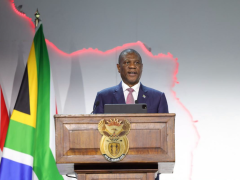
At a recent business
breakfast, SA minister of
finance, Pravin Gordhan,
told delegates that there
was a distinct need “to cut
red tape”.
While hinting that
this might be a problem
in SA, Gordhan pointed
to Rwanda as a prime
example of a country that
had learnt this lesson.
This is confirmed in
the World Bank’s ‘Ease
of Doing Business’ index,
compiled from a survey
covering the ease/difficulty
of establishing businesses,
using reports from
entrepreneurs in more
than 135 economies.
Where it relates to the
freight and trade sectors
is that it is, above all,
a benchmark study of
regulation (that infamous
“red tape). And, one of the
10 sub-indices the bank
used to gauge a nation’s
ranking on the index was
‘Trading across borders
– Number of documents,
cost and time necessary to
export and import’.
In sub-Saharan Africa
in the past 12 years the
big improver has been
Rwanda, according to
the World Bank report.
That country has made
getting credit easier and
introduced provisions
allowing a wider range
of assets to be used as
collateral. More recently,
in 2013, it provided greater
f lexibility in the types of
debts and obligations that
could be secured through a
collateral agreement.
The end results of this
World Bank study make it
quite clear which are the better
African states to do business
with and which the worst.
Top 5 easiest countries to
do business with in sub-
Saharan Africa:
Mauritius 32
Rwanda 62
Botswana 72
SA 73
Seychelles 95
The bottom 5:
Chad 183
DRC 184
Central African
Republic 185
South Sudan 187
Eritrea 189
The Top 10 globally
Singapore 1
New Zealand 2
Denmark 3
South Korea 4
Hong Kong 5
UK 6
USA 7
Sweden 8
Norway 9
Finland 10