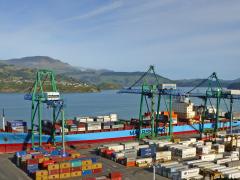
Seasonal import volumes on Safmarine’s Safari (SA-Far East) service picked up as expected during the third quarter, although the increase in volumes was below that experienced in 2007 and 2008, says Safmarine’s South Africa trades executive Alex de Bruyn. “Safmarine provided two extraloaders (on a round-trip basis) as part of its Safari 1 service at the end of August and early September to serve the additional/seasonal demand for capacity. A third extra-loader was expected to be provided before the end of September subject to demand.” De Bruyn expects import volumes from Asia to South Africa to follow the ‘normal’ seasonal import volume trends for September and October 2009, with import volumes from the region tapering down towards the end of October. Although he does not foresee a change in capacity for the Safari service for 2010, the decision to upgrade capacity would depend on demand and affordability. He also said that as demand equalled capacity, lines would give preference to higher paying cargo. “There is a need to up the rates on the Safari trade. We saw a huge and dramatic drop in freight rates on the SA-Far East trade in 2009 and the current levels are simply not sustainable.” De Bruyn believes the drop in rates on the Safari trade was the result of offpeak flows being lower than normal due to the global slowdown, but it was also most likely influenced by the huge decline in rates on the East-West trades. “While the market may expect the rate trend on the north-south Safari trade to follow that of the larger eastwest trades, the truth is that the northsouth trades in general – and the endto- end South Africa-Far East (Safari) trade in particular – are very different (size and cost-wise) to the large eastwest trades trade between Asia and Europe/USA. Simply put, the trade is unable to sustain the dramatic rate declines we saw during 2009.”
Rates remain low as seasonal flows on Safari pick up
Comments | 0
© Now Media. This content is protected by copyright and may not be adapted or republished. If you would like to discuss cooperation opportunities, please contact: editor@freightnews.co.za.