The feasibility study into
the Swazi rail link between
Lothair in Mpumalanga and
Sidvokodvo in Swaziland is
complete and ready to be taken
to market to secure funding.
Authorities in South Africa
and Swaziland have granted
the project the necessary
environmental permits and
water-use licences, and the
process to purchase 506
hectares of land in South Africa
has also been approved.
The 150km greenfields
project is designed to carry
150 general freight wagons
and will be operated as a nonstop,
single service. The line
gives TFR the opportunity to
divert up to 22 million tonnes
of general freight off the coal
line and through Swaziland.
Currently, between 15 and
17 million tonnes of general
freight traffic runs on the coal
line.
This diversion will free
up the coal line to almost
exclusively move coal,
with rail capacity
then able to match
capacity in the
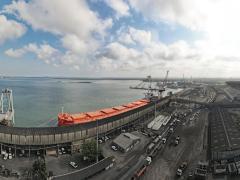
Richards Bay
port. Longer trains
can also now be
run, thus doubling
TFR’s capacity
through Swaziland.
The link is
expected to reduce the cost of
transport, as the new line is far
more direct between Swaziland
and the South African port. It
also supports TFR’s regional
integration efforts in SADC
and promotes intra-Africa
trade, bolstering economic
sustainability.
“The project is gaining
momentum,” said Swaziland
Railways CEO, Stephenson
Ngubane.
“The standard
of this link is
going to bring
efficiency and
capacity. It’s a
complex project;
in Swaziland
we have had to
exhume and
relocate over
500 graves and
we’ve cut across
15 chiefdoms,” he
explained.
TFR said
the link was a high priority in
terms of regional integration,
as it also linked Mozambique
and Botswana. “It is
highly strategic;
the vision is to
create capacity
that unlocks the
Waterberg area’s
coal reserves,”
said Transnet
chief capital officer,
Krishna Reddy.
Transnet recently signed
a 10-year contract with
Exxaro, which operates in
the Waterberg area. “We can
provide more capacity on
the coal line to move greater
volumes at a much lower rate.
We need to ensure the region
remains competitive in a very
tough commodity market.”
He said many of the major
risks Transnet incurred when
engaging
the private
sector for
partnership
had been
removed ie,
getting the
necessary
regulatory
permits,
acquiring
land and
providing
volume
security.
“This gives
the private sector greater
confidence and opportunity to
co-invest.”
Chief executive at Transnet
Freight Rail (TFR), Ravi
Nair, said the line would not
become a concession. “We are
looking at some kind of special
purpose vehicle (SPV) wherein
Swaziland Railways, Transnet
and a potential funders have
equity participation.
“The SPV will be used to
attract project financing. The
revenue generated will then
be used to pay back and meet
operating costs. It’s not a case of
one takes all. There will be an
entity that is responsible after
20 years or 25 years – when
the loans have been repaid –
after which the model will be
dissolved,” he said.
INSERT & CAPTION
In Swaziland we have
had to exhume and
relocate over 500
graves and we’ve cut
across 15 chiefdoms.
– Stephenson Ngubane