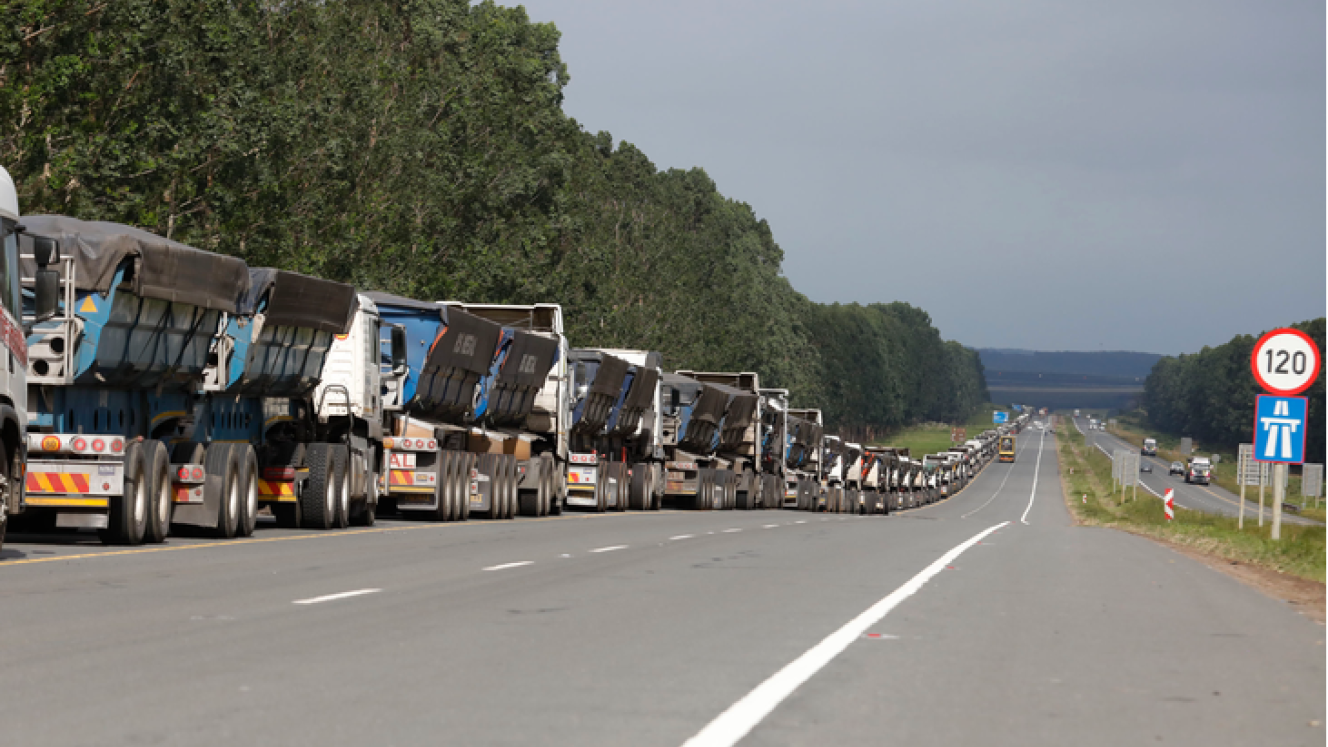
As part of its efforts to curtail the overloading of road transport vehicles, the government has just enacted a series of new regulations under the National Road Traffic Act 1996. And, according to a legal opinion released to FTW, while these are rather vague in nature, their imposition from an effective date of February 1 could see any person contravening the amended act being hit with a heavy fine – or even up to a year in jail. Don’t relax if you’re the person contracting the transport or the one receiving the sent goods. Now you, along with the road transporter, could be found guilty of the offence. This is because the new regulations on overloading stipulate that: “A consignor or consignee is prohibited from offering goods or accepting goods, as the case may be, if the vehicle is not loaded in terms of the Act (Regulation 330A(1)”. And, added to that, is a second clause stating: “The regulations also prohibit a consignee or consignor from concluding a contract with an operator if the vehicle is overloaded (Regulation 330A (4)”. So it’s not like the old days when you (as a consignor or consignee) could say: “It’s not my fault”. As part of his advice memo to members, Kevin Martin, chairman of the Durban Harbour Carriers’ Association (DHCA), focused on this triple whammy. “The law,” he told FTW, “should bring the present ‘double loading’ of heavy containers to an immediate end – as this is an unfair and unlawful practice. It will now make both the loading point and the receiving point liable for prosecution – and not just the transporter. “Further, liability cannot be contracted out, so – in the event of an accident/death/or claim – the claiming party now has recourse to the ‘party with the deepest pockets’ within the logistics chain, not necessarily the party directly responsible.” Now Peter Lamb of the legal firm Norton Rose Fulbright was the lawyer who told FTW about the lack of clarity in the new regulations. Also, with certain elements of vagueness in their wording, enforcement of these regulations may prove impossible, he added. Given this, he focused on the regulations that were intended to control overloading. And the demands made on the consignor at the time of loading allow anything but a thumb-suck estimation of the load. “These additional obligations that the regulations impose on a consignor are breath-taking when one considers what facilities a consignor would need to have access to in order to comply with them,” said Lamb. “He’d need to have, for example, weighbridges or other mass-measuring apparatus.” The regulations require the consignor to have a method of determining the mass of a vehicle and any axle or axle unit of such vehicle. This is to ensure that the vehicle axle or axles are not overloaded in terms of the National Roads Traffic Act (Regulation 330B(1). Lamb also noted that a consignor was now obliged to keep a record of the mass of every load transported from his premises (Regulation 330B (2), and that this had to be made available to any traffic officer upon demand (Regulation 330B (3). “So, in summary,” said Martin, “the consignor is obliged to obtain from the operator a written submission as to the payload of the vehicle and the distribution of the load on the vehicle. He must have in place a method of determining the mass of a vehicle and any axle or axle unit of such vehicle. And he must keep a record of the mass of every load transported from his or her premises.” As his contribution to avoiding overloading, Martin told FTW that details of his vehicle fleet’s maximum payloads would be on every vehicle. “When it comes to loading to a vehicle’s maximum payloads, all vehicles have a ‘theoretical payload’ (where load distribution is perfect – or ‘on a match stick’ as the colloquial term goes) and a practical ‘working mass’ payload. “All payloads I have given are of the latter – practical working mass payloads “I suggested to all the DHCA members that they also supply these details to all their loading and off-loading points – the packing stations and terminals.” And bringing the consignee into the overloading regulations also has its own unclear legislative area, according to Lamb. “The consignee,” he said, “is prohibited from accepting goods if the vehicle is not loaded and transported in accordance with the act. He/she is also prohibited from entering into a contract with the operator to transport the goods if the vehicle is overloaded.” Just how a consignee – who is totally separate from the vehicle loading procedure – would know whether the vehicle was loaded in accordance with the act is one unclear area, according to Lamb. Or what additional steps the consignee would need to take to ensure compliance, presumably on the part of the operator, with the act. “The regulations create a further anomaly,” he told FTW, “and assume that the time of entering into the contract to transport the goods occurs at the same time the goods are loaded. “But, in practice, these contracts may be entered into well before the goods are loaded onto the transporting vehicle.” In Lamb’s opinion, if the operator ‘breaches’ the contract by subsequently overloading the vehicle, the consignee may arguably have no right of recourse against the operator. “One of the requirements to enter into a contract is that the contract must be lawful,” he added. “In effect, the regulations render the contract to be unenforceable as it is expressly prohibited by Regulation 330(A). “This outcome is irrational. However, until the Regulations are amended to rectify this anomaly, we recommend that consignees and consignors comply with Regulation 330A as far as possible.” INSERT & CAPTION 1 With certain elements of vagueness in their wording, enforcement of these regulations may prove impossible. – Peter Lamb INSERT & CAPTION 2 The new regulations make both the loading point and the receiving point liable for prosecution — and not just the transporter. – Kevin Martin
Punitive new overloading regulations enter into force
Comments | 0
© Now Media. This content is protected by copyright and may not be adapted or republished. If you would like to discuss cooperation opportunities, please contact: editor@freightnews.co.za.