Cost-deficient practices will be addressed
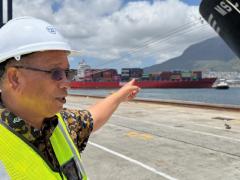
Tau Morwe . . . customers could see tariffs going down or
remaining where they are
Joy Orlek
PORTNET'S chief executive officer: Port Operations Division (POD), Tau Morwe, has launched an efficiency and productivity drive in a determined effort to improve profits and service. But he acknowledges that it's a partnership game and any gains must benefit not only Portnet but its customers as well.
Within three years our customers must see their logistics costs reduced, Morwe told FTW in Johannesburg last week.
In the past Portnet has been too internally focused. We will now become a far more customer centred organisation and have already initiated certain projects with the likes of Iscor to see what we can do to address issues around efficiency, he said.
But improving its service to customers will clearly need to begin with an improvement in internal efficiencies, and this will involve a
radical rethink of the current
mindset. Morwe has already isolated several cost-deficient practices.
When you look at the income statement there are issues that just pop up like maintenance, labour, interest paid arising from the capital expenditure.
In Richards Bay, for instance, the operations division is losing money and yet the capital expenditure programme is not tied to any business strategy. If we tie down capital expenditure to strategy we can address that problem.
Maintenance of equipment is a further area of concern. Portnet equipment is very expensive, but we do not have a maintenance strategy in place, and as a result the bill just keeps escalating. It's an area where initially we will have to invest a significant amount of money, but which will bring long-term benefits resulting in less down time and therefore a better service to customers.
Staff issues also need to be addressed as a matter of urgency, says Morwe.
The age profile of Portnet is above 50 and as a result there are problems with absenteeism and with temp or casual labour. As an example the total labour bill of the combi terminal in Durban for the past financial year was around R60m. R15m of that was due to overtime, casuals and other related problems. If you could target that R15m there would be a significant saving.
Morwe is also keen to introduce a culture of multi-skilling so that a straddle carrier driver, for example, is not only equipped to perform that particular function but can help out in other areas when required
The issue of storage also lends itself to process improvement in Morwe's view. When I visited Richards Bay in 1997 there were a number of Iscor's rolled steel coils in the storage area. These are still there today.
He sees additional cost savings in the area of procurement.
And if Portnet's productivity programme bears fruit, customers could see tariffs going down or remaining where they are, says Morwe.
Copyright Now Media (Pty) Ltd
No article may be reproduced without the written permission of the editor
To respond to this article send your email to joyo@nowmedia.co.za