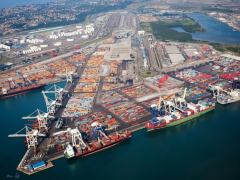
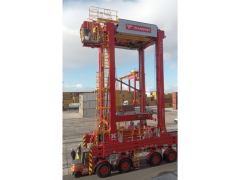
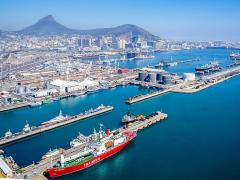
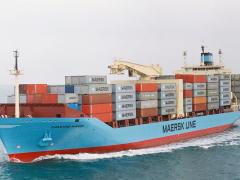
WINDY MONTHS are a fact of life in Cape Town, but even so operational port stoppages coupled with berth deepening at the container terminal are impacting heavily on liner schedule integrity, says Mike Economou, Cape regional director for Mediterranean Shipping Company (MSC). Economou readily concedes that the R4.2- billion expansion of the terminal, which includes berths deepened to 15.5 metres, eight new super post-panamax cranes and stacking space increased from some 800 000 teus to 1.4 million teus a year, is to be welcomed. However, the price of progress never comes cheap. First, deepening of each berth, one at a time, will take a year, with completion of all four no earlier than 2012. The new cranes will be delivered in pairs piecemeal over the next four years, the first two due in June. Describing as “a nightmare” the combination of wind and berth deepening of berth 6 01, which has encroached onto 6 02, so reducing capacity even more, Economou says MSC’s seven-vessel schedule integrity to Europe was excellent last year but he seriously doubts whether the pattern can continue. “The deepening project has had a tremendous impact on the berthing of vessels and as a direct result the port can basically only work two large vessels at a time. If one considers that between MOL, Safmarine, Maersk and MSC we have 14 large vessels of approximately 300m, and an average of two days dwell time in port, you can see that on any given day one large vessel will be in port thus allowing space for one smaller one or, alternatively, another larger vessel. Only in exceptional cases where there is no large vessel can they berth three small vessels. So there is no doubt the impact on us will be immense.” A contingency plan is in place for Cape Town’s multi-purpose terminal to handle 30 000 containers but MSC cannot use these facilities as it deploys the largest ships, 5 000-teu or more, operating in South African waters. MSC has only diverted one vessel recently but Economou says delays such as those currently being experienced in the Mother City port are having a knock-on effect down the coast, Port Elizabeth having to be omitted on the northbound call of the carrier’s weekly South Africa-Europe service. “Sailing out of South African waters is as much as five or six days late which results in cutting out European ports, so the situation is dire.” On a more positive note, Economou says he is more optimistic about Transnet National Port Authority’s marine services. “There certainly seems to be a bigger effort toward improving that service. They understand the urgency due to the container terminal extension and that they have an undertaking to assist us in terms of berthing and unberthing. However, only time will tell.”
Port expansion delays force lines to cut ports
Comments | 0
© Now Media. This content is protected by copyright and may not be adapted or republished. If you would like to discuss cooperation opportunities, please contact: editor@freightnews.co.za.