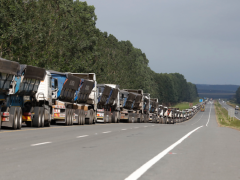
Congestion, delays and bureaucratic red tape are all terms that can aptly describe Southern Africa’s busiest border posts. “Inefficient border posts can deter and hold back regional trade, hinder foreign investment and create a negative environment for the regional countries from a business, passenger as well as tourism point of view,” says Horne-Ferreira. “Quite simply, the less time spent on border crossing formalities, the lower the cost of logistics and eventually the cost of doing business.” An earnest campaigner for not only One Stop Border Posts (OSBP) but also 24-hour border post operations, Horne-Ferreira says it is important to come up with policies, processes and procedures that are simple and easy to use. Creating a 24-hour border post or an OSBP requires buy-in from all stakeholders, and sadly, borders are just not a top priority for government, says Curtis. “A 24-hour border posts requires more staff and therefore more housing. As borders are not always a priority, the request for the extra expenditure is not always seen in a positive light.” But not all borders need to operate 24 hours a day. Experts say only those with heavy goods vehicle traffic flow should qualify. “Those that should be 24-hour and aren’t experience extra delays as a result,” says Curtis. “However moving to 24 hours from say 8 hours will not cut the transit time by two thirds. There aren’t clear statistics on this, but only a maximum of 30% can be expected.” He says it is important not to rush into a 24-hour border post. “Beitbridge has shown that it is very difficult to make it work and not all of the stakeholders at the border comply with the 24 hours. For example, agents will only work on the clearing of trucks up to 10pm. Even Customs does very little work after this time. Only the release of trucks takes place in the wee hours,” says Curtis. Ensuring successful border operations, be it for a 24-hour border post, an OSBP or both, needs all the stakeholders on board, says Curtis. “And decisions that are made must be sustainable.” Horne-Ferreira says the Lebombo/Ressano Garcia border has in the past five years seen an estimated 100% increase in the flow of freight. “As the border does not operate 24 hours a day, the daily closure of the border leads to the accumulation of traffic overnight, which in turn results in border service providers having to staff at higher levels over morning peak hours to cope with the influx.” With companies exporting and importing through this border claiming huge economic time loss due to the early morning congestion, there is no doubt that longer working hours at a border post can greatly benefit trade. “It also impacts on road safety,” says Horne-Ferreira, “as there is ample evidence that the current closure of the border leads to drivers ‘racing’ to the border to make the crossing on time. This results in increased speed and reckless driving and drivers not taking the necessary rest breaks.” Improving the operational efficiency of border posts in Southern Africa is the first step towards ultimately seeing the free movement of goods and people within SADC like in the EU. “The different streams of border traffic move at different paces and unless you separate them, you will find huge wastage across all users,” says Horne-Ferreira. “We will simply have to come up with out of the box solutions for the problems we are facing.” This includes leaning much more on electronic systems and implementing state of the art technology. “It is also crucial that the different countries start to trust each other and share electronic information rather than people being processed twice,” she says. “I do believe though that with the necessary positive attitude, sufficient staffing levels and motivation, the public sector can cope with the changes needed to bring about 24-hour OSBPs. It is however a reform process from top to bottom.”
One-stop borders demand buy-in from all stakeholders
Comments | 0
© Now Media. This content is protected by copyright and may not be adapted or republished. If you would like to discuss cooperation opportunities, please contact: editor@freightnews.co.za.