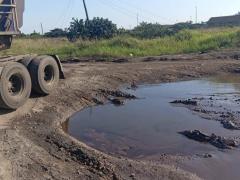
A new concept in offshore ports could offer significant benefits to the shipping industry in Africa, in the view of Marco Pluijm, ports sector manager of the US-based global engineering, construction and project management company, Bechtel. “As container vessels get increasingly larger, leading to cascading of ships and further consolidation of shipping routes, existing ports are under pressure to efficiently handle larger ships,” he said. “Offshore ports can provide these solutions, and can also serve as hubs for existing ports. “They can handle higher quantities of containers and bulk goods, and achieve substantial savings in both operational and capital costs – in the region of 40-60% in Africa.” Pluijm is adamant that there is a need for offshore ports in Africa. When it comes to the choice between adjusting existing ports or creating one or more hubs, the multi-user offshore hub (MUOH) is a viable solution, he said. The MUOH concept, he added, originates from the mining industry. “It is an offshore facility at adequate water depth, where no dredging is required, and is able to handle Cape Sizers and the even bigger Valemax. “Fed by barging – of 10 000 to 50 000 deadweight tonnes (DWT) – it provides an uptime of 90% minimum. “And, where it’s possible, a combination with river transport provides significant additional advantages over rail or road. One particular business case analysed by Bechtel related to possible MUOH savings in Mozambique, where a capacity of five to 40 million tonnes per year to meet the mines’ output was required. The investment costs compared in this study were an inland port, a coastal port, and an MUOH; rail track and facilities, locos, wagons, etc.; and the purchase of barges, to minimise the cost of up-front infrastructure investment needs. The operational costs included the shipping charter rates and fuel consumption for Panamax, Cape Size and Valemax; the maintenance of rolling stock, barges, etc.; and the maintenance dredging of the river and coastal port. And the outcome for the MUOH, according to Pluijm, was a substantial reduction in Capex of 37-45 %, and in Opex of 28-58%. This compared to the base case, which was by rail to the coastal port and by Panamax vessels for the route to China. And an independent second opinion from the consulting engineers, Moffatt & Nichol, came up with overall results about the same or even better in terms of cost reductions. A second area in Africa has also come under Bechtel’s microscope – the Simandou iron ore mining project in Guinea, where the plan is for initial iron ore exports of 50m tonnes per annum (mtpa), ramping up to 100 mtpa and even more. The current plan, according to Pluijm, is for a river port, suitable for Cape Size vessels up to 250 000 DWT. But this, he said, would require dredging of the river and a 35 kilometre offshore channel, with anticipated maintenance dredging of 20 to 50 million cubic metres a year. “It’s a perfect spot for an offshore port,” Pluijm added, “fed by 30 000 to 45 000 DWT barges, serving Cape Size vessels and even bigger when required". “With one or more MUOHs in place in Africa, the feasibility of mining and all kinds of infrastructure projects comes within reach, boosting economic growth and prosperity for those regions.” But mining apart, Pluijm reckoned that the MUOH is also an ideal option for containers. He pointed to an ongoing consolidation of shipping routes; the economy of scale key (number of TEUs, slow steaming, fuel consumption, emissions, etc.); the Triple EEE being the current largest container vessel, but even bigger ones now on the drawing board; and the cascading down of previous generation vessels. “Consequently,” he said, “all major container ports are (potentially) facing bigger size containerships. These ports and their facilities need to be adjusted accordingly (water depth, crane reach and the like). “But an alternative is an adequate offshore handling facility (port), in combination with short sea shipping and feedering.” Pluijm’s conclusions were that there was a sharp increase in demand for deep water ports, driven by economy of scale in the container industry and bulk shipping. CAPTION There is a plan to build a river port in Guinea which is suitable for Cape Size vessels of up to 250 000 DWT. Photo: Wikimedia
Offshore ports concept presents major opportunitiy in Africa
Comments | 0
© Now Media. This content is protected by copyright and may not be adapted or republished. If you would like to discuss cooperation opportunities, please contact: editor@freightnews.co.za.