Transport minister Blade Nzimande has challenged the Sector Education Training Authority (Seta) to help develop skills training for the manufacturing and repair of ships. “One of the most promising new areas of economic growth is that of promoting coastal shipping, yet we do not manufacture ships and we repair only 3% of ships that visit our shores,” said the minister during his speech at the Transport Sector Education and Training Authority (Teta) Skills Summit in Johannesburg last week. Nzimande said it was important that Teta incorporated the production of skills for new economic initiatives and avenues in the transport sector into its own training strategy. He pointed out that South Africa’s oceans had the potential to contribute up to R177 billion to the gross
domestic product (GDP) and create just over one million jobs by 2033. “As the Department of Transport, we are leading the Marine Transport and Manufacturing work stream of government’s oceans economy strategy, Operation Phakisa,” he said, adding that the department’s work stream had recently highlighted a concern that South Africa currently had no registered ships. “This is in spite of the fact that each year 300 million tonnes of cargo moves through our ports in imports and exports. In addition, 1.2 million tonnes of liquid fuels move along our coast, while the rapidly expanding offshore oil and gas activities require a supporting fleet of vessels,” Nzimande pointed out. In his view South Africa is “ideally positioned” to serve
the east-west cargo traffic and the booming African offshore oil and gas industry through marine manufacturing, which includes ship and rig repair, refurbishment and boatbuilding. Yet despite this competitive geographic advantage, SA currently captures only 1% of the global market of ship repair and replenishment. “Of the eighty oil rigs estimated to be in the range of the Western Cape, only four rigs are serviced per year, showing significant potential for growth,”
Nzimande pointed out. “But, to take advantage of this, the right skills are needed.” He said that some of the targets identified by the Marine Transport and Manufacturing work stream included an increase in the local manufacturing capacity through a 10% increase in the usage of local components for boat and ship building, upping the ship repair capacity in Richards Bay, and creating a dedicated education, training and skills development focus for the sector.
CAPTION
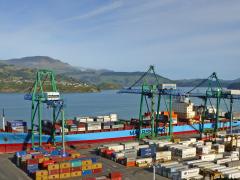
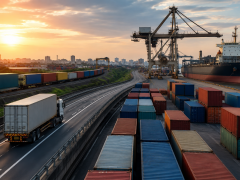
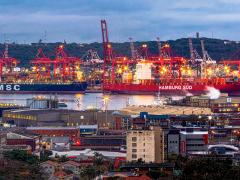
Each year 300 million tonnes of cargo moves through our ports in imports and exports.