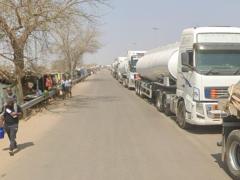
A flower seller’s stall in the Avondale suburb of Harare captures the Zimbabwean economy in a basket. The brightly coloured, high-quality flowers are freshly picked on local farms – in a country where commercial farming has all but collapsed. There is a market. The flower sellers assured FTW that all the arrangements would be sold by evening, despite competition from other flower sellers in the suburb and elsewhere in the city – this in a country with an estimated 80% unemployment. It is estimated that there are 500 000 people in formal employment – half of whom work for government. The economy survives because of the tenacity and inventiveness of flower sellers such as those on the side of the road in Avondale. They source the flowers, baskets and filler material themselves, and then craft the arrangements on site. There is plenty of passing traffic. The volume of vehicles on the road is growing noticeably. All are imported – in a country where there is a shortage of foreign exchange. According to official statistics published by Zimstat, the country imported passenger vehicles worth between US$14 400 and US$20 600 a month in the first eight months of 2014. An imported used 1997 Toyota RAV4 sells for as little as US$2 250, and a 1999 Corolla for US$1 790. Prices at one dealer go up to US$12 000 for a RAV4, and US$4 300 for a Corolla – in a country where banks are failing due to lack of liquidity. Around 20 banking institutions have closed since 2000, many taking their customers’ deposits with them. Business has adapted by paying creditors as soon as a debtor makes a deposit, banking offshore or working with cash. The cash-based economy goes largely unrecorded, and revenues collected by government continue to decline. VAT collections in 2014 were about 7% below budget, according to the Ministry of Finance. Prospects for recovery are not particularly hopeful, according to researchers Mary Manneko Monyau and Amarakoon Bandara of African Economic Outlook. In their 2014 review they write: “Zimbabwe’s economy remains in a fragile state, with an unsustainably high external debt and massive deindustrialisation and informalisation. “The average GDP growth rate of 7.5% during the economic rebound of 2009- 12 is moderating. “This economic slowdown is due to liquidity challenges (eg, the lack of and high cost of capital and revenue underperformance), outdated technologies, structural bottlenecks that include power shortages and infrastructure deficits, corruption and a volatile and fragile global financial environment.” And yet entrepreneurs are still selling flowers and exclusive boutiques in Harare’s up-market Sam Levy Village keep their doors open. There are also South African brands – among them Food Lovers Market – whose shelves are packed with fresh produce. And imports of fast-moving consumer goods remain strong – in a country with an estimated 250 000 “extremely poor” households according to government estimates. Digging a little below the surface one finds some answers. Freight keeps flowing because much of the economy has gone underground. Cash cannot be tracked, and it is safer having dollars under a mattress than in some banks. The Zimbabweans have also become past masters at barter. Then, of course, there is smuggling. Porous borders make it easy to move highvalue items such as gold, diamonds and cigarettes. A direct impact on the freight industry has been delays and additional costs at the Beitbridge border post. ZIMRA has installed two Chinesemanufactured scanners which can process up to 20 vehicles an hour. Once on the road truckers have to deal with more than 15 roadblocks between Bulawayo and the Beitbridge border, according to The Herald newspaper. Despite all these challenges, the freight and trading industries continue to operate – and in some cases grow. Zimbabwe is home to some of the most sophisticated and modern logistics and trucking operations ever visited by FTW. There are opportunities – but it is definitely not a market for sissies. INSERT Around 20 banking institutions have closed since 2000, many taking their customers’ deposits with them. CAPTION 1 Despite the country’s economic woes, exclusive boutiques in Harare’s up-market Sam Levy Village keep their doors open. CAPTION 2 A flower seller with high-quality flowers freshly picked on local farms – in a country where commercial farming has all but collapsed.
Not a market for sissies!
Comments | 0
© Now Media. This content is protected by copyright and may not be adapted or republished. If you would like to discuss cooperation opportunities, please contact: editor@freightnews.co.za.