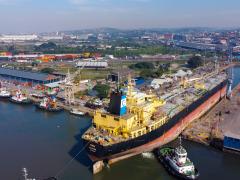
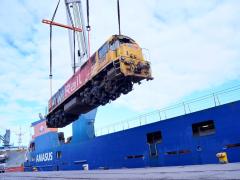
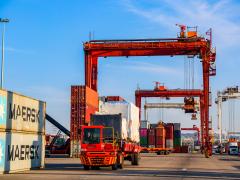
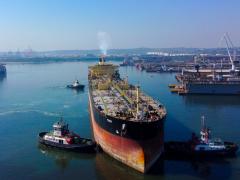
Namibia’s corridors are not only becoming a more cost-competitive option, but are also offering deeper regional integration, linking countries and moving Africa’s minerals quickly. “They are definitely competing effectively with the Southern African routes and corridors,” says Philip Coetzee of Manica Namibia. “The key is to find a balance between inbound and outbound cargo as this secures capacity on these routes and competitive transport rates.” The main focus in terms of commodities is chemicals, equipment and consumables for inbound cargo, while copper, manganese, zinc, charcoal and uranium form the bulk of the outbound cargo. “The three corridors – the Trans Kalahari linking Walvis Bay with Gaborone and Gauteng, the Trans Caprivi which links Walvis Bay with Zambia, the DRC and Zimbabwe as well as the Trans Kunene which links Namibia with Angola – have all seen major development in recent years and continue to do so,” says Johny Smith, Walvis Bay Corridor Group (WBCG) business development executive. “We are seeing phenomenal growth and hope to continue to do so. On the Trans Caprivi corridor, which has a transit time of three to four days from the Port of Walvis Bay to Zambia, we have seen 60% growth alone. If you take into consideration the port development of more than N$450 million, the improvement in shipping services and the increase in container capacity, it makes sense to use these corridors.” Coetzee believes the focus for 2010 will be on mining houses committing to certain volumes over a period of time. “This will ensure capacity stability from a logistics point of view. The benefit for the customer can be price, alternative routes, additional capacity, faster access to the market, security and reliability.”
New route to Zambia grows 60% as cargo zips through
Comments | 0
© Now Media. This content is protected by copyright and may not be adapted or republished. If you would like to discuss cooperation opportunities, please contact: editor@freightnews.co.za.