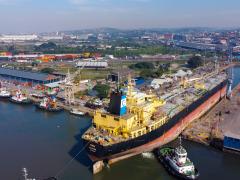
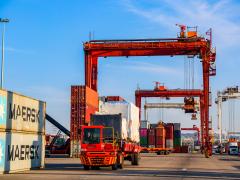
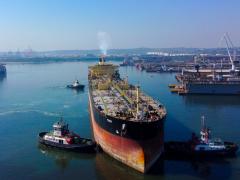
It’s official. Durban ranks among the most expensive ports in the world. That’s according to the latest ‘must-read’ for everybody in the shipping and freight industries – the Port Regulator’s “Port Benchmarking and Indicators Research”. It’s the most magnificent compilation of port comparative statistics you’re likely to come across – and in SA terms it’s a definite gold medal winner. It is an in-depth study of all the Transnet National Ports Authority (TNPA) costs at the SA port network and certain individual ports, Port Regulator CEO Riad Khan told FTW. If you want to know how much a container vessel had to pay in total maritime and infrastructure costs on April 1 per ship call (excluding harbour dues), you’ll find that Durban (at US$27 933.50) comes in well behind Rotterdam (at US$40 176.97). But, including cargo dues, Durban steams out into the front for total cost (at US$182 151.30). Although that’s closely followed by Long Beach, Los Angeles and Port Klang costs, it’s still over twice the US$86 251.58 average for the 12 ports and a massive 879% above the lowest costing of the 12 (Kaohsiung). Put together internally, Khan said the report answers almost all of those niggling questions you’ve ever had about the ports. It’s divided into three parts: Part A is: “A TNPA tariff comparison with selected ports for a unitary bulk vessel that is exporting coal out of each port.” (This uses the Port of Richards Bay compared to 10 other major ports around the globe). Part B: “A TNPA tariff comparison with selected ports for a unitary container vessel calling at each port.” (This uses Durban compared to a total selection of 11 other major ports around the world). And Part C: “Port comparators for selected international ports and TNPA national and individual port indicators over time.” Another distinct plus mark for the research is that – although some figures, like global port rankings – use 2008 figures, the vital figurework, like the tariffs and costs, are all in April 1, 2010 terms. As up-to-date as you could expect. And it’s not necessarily written in stone, because this has been released publicly for everyone to read and absorb – and question if need be, according to Khan. “This series of research on port benchmarking and port performance is published for comment, criticism and relevance testing,” he told FTW. “The research is intended to commence the process of long-term key performance indicators (KPI) monitoring and to provide information that assists stakeholders to better engage with the Regulator in its various programmes.” Khan invited FTW readers to look at the research and submit any comments they have by December 15. Not that the issue is even then finally signed, sealed and delivered. “Comments beyond this period would also be appreciated,” he added. If you are questioning the relevance of particular indicators and comparisons, you are welcome to indicate why they are not relevant and which indicators should be used to replace them that better serve the information or monitoring needs of such stakeholders. Any doubts about the ports selected as comparators can also be expressed. If you feel that any of the ports are not appropriate, suggest those which should have been used instead. Also why your preferred ports should be used in the future. (Just remember that the ports chosen have all released their latest stats publicly – and many of the other ports are either very sluggish in releasing their figures, or keep them totally secret.) To view this analysis go into web-site: http://www. portsregulator.org/ When the home page is downloaded, click on “Latest News” in the top right. Then click on “Port Benchmarks and Indicators Research” – and you’re in. Here are answers to a few of the frequently raised questions. How fast do the gantry cranes work? In Durban 2008, they managed 23 crane moves per hour. Antwerp managed 94 per hour, and the 51.33 average was 123% more than Durban’s. Not that you should think that things must be better in 2010 – the crane moves per hour in Durban actually fell to 22. Things have improved in 2010 in the average vessel turnaround time. In 2008, your container ship took 72 hours on average in Durban. It was followed by Los Angeles at 61 hrs, but was still almost twice the average for the six ports chosen, and five times the wait at the best (Laem Chabang). But in 2010, Durban had done enough magic to bring down its turnaround time to 45 hrs average. This placed it well ahead of the LA time in 2008 – although the other port figures are not yet available for 2010. How much does it cost per ton to handle cargo? According to TNPA figures, the SA port network moved 12 602-tonnes for each R1-m in assets in 2005. In 2010 – when the total asset value had moved up by over 165% – it moved 5 453-t/R1-m. In 2008 the TNPA operating expenses (rands) per tonne of output were R6.30. In 2010 they were R7.69/t. It’s all there – and well worth a read.
New report reveals Durban as one of most expensive ports in the world
Comments | 0
© Now Media. This content is protected by copyright and may not be adapted or republished. If you would like to discuss cooperation opportunities, please contact: editor@freightnews.co.za.